 RECOMMENDED BOOKS, ARTICLES AND WEB SITES
There has not been much written on the image of journalists in movies, television, radio or fiction. The IJPC hopes to rectify this in the future. In the meantime, the Image of the Journalist in Popular Culture recommends the following books, articles and Web sites. Categories are presented in this order: Popular Culture, Films, Television, Radio-Podcasts, Novels and Short Stories, Poetry, Public Relations, Art and Photography, Comic Books, and Music.
Please e-mail us at .(JavaScript must be enabled to view this email address) if you have any additional recommendations for this resources page.
Updated: 10-2025
POPULAR CULTURE
Click Here for Alphabetized List of Authors on Journalists in Popular Culture
Analyzing the Images of the Journalist in Popular Culture: A Unique Method of Studying the Public's Perception of Its Journalists and the News Media: “A long-neglected, fertile field for research virtually untapped by journalism and mass communication scholars”by Joe Saltzman, Professor of Journalism, Director of the Image of the Journalist in Popular Culture (IJPC), A Project of the Norman Lear Center, Annenberg School for Communication, University of Southern California. By analyzing the images of the journalist in popular culture over the centuries, the researcher can offer a new perspective on the history of journalism as well as the delicate relationship between the public and its news media. The anger and lack of confidence most of the public has in the news media today is partly based on real-life examples they have seen and heard, but much of the image of the journalist is based on images burned into the public memory from movies, TV and fiction. These images of the journalist have an enormous influence on how the public perceives and judges the news media and they have a profound effect on public opinion and consequently, the public’s support of the effectiveness and freedom of the news media. Many of these images come from age-old sources, long forgotten yet still relevant in the 21st century. Variations of this paper were delivered at the “Media History and History in the Media” conference at the University of Wales, March 31-April 1, 2005 at Gregynog, Wales, and at the Association for Education for Journalism and Mass Communications (AEJMC) in San Antonio, Texas, August 12, 2005.
Herodotus as an Ancient Journalist: Reimagining Antiquity's Historians as Journalists by Joe Saltzman, The IJPC Journal, Volume II, Fall, 2010, pp. 153-185. This paper was presented at the Association for Education in Journalism and Mass Communication (AEJMC) in a scholar-to-scholar History Division Referred Paper Post Session on Friday, August 6, 2010 in Denver.
Thucydides: The First Journalist with IDEAS Producer Nicola Luksic, CBC Radio, August 21, 2011 9:00 PM. About 2,500 years ago, Thucydides travelled ancient Greece, gathering stories about a brutal war that plunged the ancient world into chaos. He set high standards for accuracy, objectivity and thoroughness in his reporting. IDEAS producer Nicola Luksic explains why his account of the Peloponnesian War is relevant today.
Rome’s Gossip Columnist: When the first-century poet Martial turned his stylus on you, you got the point by Garry Wills, The American Scholar, Spring 2008. Wills is professor of history emeritus at Northwestern University. All translations in this essay are his. Marcus Valerius Martialis, c.40–c.102 C.E., "was like later gossip columnists, out night after night prowling for what they can devour by denouncing. He is a Walter Winchell in elegiac distichs. Or, more properly, he is like the gossip columnist in Evelyn Waugh’s Vile Bodies, who makes a living off the absurdities and vices of his own society by mocking them. He is a complicitous critic, half enjoying what he sneers at, mixing entertainment with revulsion. He is a reforming voyeur, a compromised Savonarola. It is a complex role, not reducible to any one of its components."
The Image of the Journalist in France, Germany, and England, 1815-1848 by Lenore O'Boyle. Comparative Studies in Society and History, Vol. 10, No. 3 (Apr., 1968), pp. 290-317 Published by: Cambridge University Press. The study can best be focused through comparison of the attitudes towards the newspaper press, and the image of the journalist in these societies: what was the newspaper press judged to be, how did the journalist see himself, and how was he viewed by other social groups. It may be objected at the outset that journalism does not qualify as a profession, and if one adopts a rigorous definition of a profession, stressing possession of a systematic body of knowledge acquired through a long specialized training, then the objection is valid. Decisive, however, is the fact that journalism was commonly regarded in the nineteenth century as a profession and is now. It requires considerable education and experience, and the journalist does as a rule have access to certain information denied the ordinary person.
Fictional Representations of Journalism by Chad Painter, Oxford Research Encyclopedia, Communication, Journalism Studies, July 2019. Research into depictions of journalists in popular culture is important because the depictions influence public opinion about real-world journalists, as well as the credibility and public trust of the journalism field. Indeed, the influence might be greater even than the actual work pereformed by real-world journalists.
Painter, Chad and Patrick Ferrucci (2022). Building Boundaries: The Depiction of Digital Journaliss in Popular Culture, Journalism Practice, 1-17. The purpose of this study was to examine the depiction of digital journalists in popular culture. Researchers conducted a textual analysis of the films Contagion (2011) and State of Play (2009) and the television series House of Cards (2013-2018) and Veep (2012-2019). They found that digital journalists are not depicted as “real” journalists, digital journalists typically are bad when they attempt to do “real” journalism, digital journalists sometimes do “real” journalism, and digital journalists are unethical. These findings are then discussed in terms of boundary work and the impact of popular culture mythmaking on real-world digital journalists.
FILMS
Click Here for Alphabetized List of Authors on Journalists in Movies
Spanish-based Website on the international image of the journalist in film - https://periodistasenelcine.com/otras-bases-de-datos-sobre-cine/. Includes International Survey of the Best Films Featuring Journalists. More than 463 participants from 20 countries voted on the best international films on journalists in a survey created by Federico Poore (periodistasenelcine.com) of the Spanish-based Journalists in Cinema, June 2024. The results include more than 200 films headed by Citizen Kane, All the President’s Men and Spotlight. American films are joined by films from Brazil, Argentina, France, Spain, Italy, Japan and South Korea. The site is in Spanish and the link is: https://periodistasenelcine.com/top-150/
Richard R. Ness's From Headline Hunter to Superman: A Journalism Filmography is by far the best book yet written on the journalist in film. Published in October 1997, it is a superb guide to more than 2,100 feature films dealing with journalism, the definitive reference book on the image of the journalist in film. It is available from Scarecrow Press (www.scarecrowpress.com). Also From a Voice in the Night to a Face in the Crowd, the Rise and Fall of the Radio Film by Richard R. Ness, Western Illinois University. Paper delivered at the AEJMC Conference in San Francisco, August 2006. It is no mere coincidence that Hollywood conversion to sound coincided with the development of radio as a major force for both information and entertainment.That radio provided not only a source of competition but also a potential form of promotion for the motion picture industry led to an often uneasy alliance between the two media, and, as with the newspaper profession, Hollywood demonstrated a love-hate relationship in its depiction of radio and its practitioners.
IJPC Needs Your Help. Here is a list of films we still are attempting to locate as part of our research for the Image of the Journalist in Popular Culture project. The films are listed first alphabetically and then by year of release. If anyone knows of sources for any of these titles (including video and film sources, as well the availability of copies in archives), please contact Dr. Richard Ness, Associate Director of the IJPC, at .(JavaScript must be enabled to view this email address). Any assistance is greatly appreciated. Revised 8-2006.
Howard Good, coordinator of the journalism program at the State University of New York at New Paltz, is one of the few scholars in America who writes about the subject and has written three books dealing with the journalist in film: Outcasts: The Image of Journalists in Contemporary Film (1989); Girl Reporter: Gender, Journalism and Movies ( 1998), and The Drunken Journalist: The Biography of a Film Stereotype. All are recommended, filled with information available nowhere else. They are available from Scarecrow Press. (www.scarecrowpress.com). Lately, Good has been writing about media ethics. These books include one written with Michael J. Dillon, professor of communications at Duquesne University, Media Ethics Goes to the Movies (Praeger Publishers, CT, 2002) and Journalism Ethics Goes to the Movies, a book edited by Good (Rowman & Littlefield, Lanham, MD, 2008).
The best book ever written on the reporter in film is currently out of print. It was written by a Canadian newspaperman named Alex Barris, Stop the Presses! The Newspaperman in American Films (A.S. Barnes and Co., South Brunswick and New York, 1976.). It's worth seeking out. Specialty book stores may have a used copy and it occasionally surfaces in online auctions.
Also worth ferreting out is Loren Ghiglione's The American Journalist: Paradox of the Press (Library of Congress, Washington, DC, 1990), written for a Library of Congress exhibit on the image of the journalist. Dr. Ghiglione is dean of the Medill School of Journalism at Northwestern.
Fact or Fiction: Hollywood Looks at the News. An essay by Loren Ghiglione, Dean of the Medill School of Journalism, Northwestern University, and Joe Saltzman, Director of the IJPC and Associate Dean, USC Annenberg School for Communication -- © Loren Ghiglione/Joe Saltzman 2002
The American Journalist: Fictions Versus Fact. An essay by Loren Ghiglione, Dean of the Medill School of Journalism, Northwestern University. ©American Antiquarian Society, 1991.
Frank Capra and the Image of the Journalist in American Film. "The first book of the IJPC project, Frank Capra and the Image of the Journalist in American Film, sets a precedent of excellence in scholarship, writing, and readability, serving academics, students, and film aficionados alike ...Academics will find it a valuable resource, especially if teaching a course that examines the image of the journalist, a Capra course, or even a film genres course." Journalism & Mass Communication Quarterly, Spring 2003.
Frank Capra and the Image of the Journalist in American Film, USC Literary Luncheon Speech, March 27, 2002, Doheny Memorial Library © Joe Saltzman
Matthew C. Ehrlich and Joe Saltzman, Heroes and Scoundrels: The Image of the Journalist in Popular Culture, University of Illinois Press, 2015.
Matthew C. Ehrlich's book, Journalism in the Movies (University of Illinois Press), is an excellent summary suitable for class use. For more information, see an Article-Review on the book: "Journalism through the camera's eye: Book looks at how Hollywood shapes our views of the press." Ehrlich, associate professor at the University of Illinois Department of Journalism, has studied and written about journalism movies for 13 years and has been an invaluable resource to the IJPC.
Facts, Truth and Bad Journalists in the Movies by Matthew C. Ehrlich in Journalism, Vol. 7, No. 4, 501-519 (2006) © Sage Publications 2006. Scholars have called for cultural analyses of the press that are more attuned to journalists’ self-image as disciples of facts and truth while also critically examining the contradictions within that self-image. Popular representations of journalism such as motion pictures are one fruitful site of inquiry. This article studies American movies’ depictions of ‘bad journalists’, characters who in many ways contradict the image of upstanding professionalism that the press tries to promote. Although real-life journalists over the years have often objected to such portrayals, ‘bad journalist’ characters still have helped shore up the press’s preferred self-image, either by seeing through lies and pretense to the truth or by paying the price for not telling the truth.
Hollywood and the Journalistic Truthtelling by Matthew C. Ehrlich, Associate Professor of Journalism at the University of Illinois at Urbana-Champaign. This article was published in the Notre Dame Journal of Law, Ethics & Public Policy, 19(2), 2005: 519-539. Ehrlich's book Journalism in the Movies (2004) was published by the University of Illinois Press. The article looks at what has been called the paramount principle of journalism -- truthtelling -- as it is depicted in a movie about a notorious real-life case of journalistic deception: Shattered Glass , the story of Stephen Glass who in 1998 was fired for fabricating more than two dozen stories for the New Republic magazine.
Other excellent writings on the subject by Ehrlich include Journalism in Movies, Critical Studies in Mass Communication, Vol. 14, 1997, pp. 267-281, a critical overview of the genre; Thinking Critically about Journalism Through Popular Culture, Journalism & Mass Communication Educator, Vol. 50, No. 4, 1996, pp.35-51, a documentation of a class on the subject taught by Ehrlich, and The Romance of Hildy Johnson: The Journalist as Mythic Hero in American Cinema, Studies in Symbolic Interaction, Vol. 12, 1991, pp. 89-104.
An extensive, but unpublished, survey of journalists in film was compiled by Maxwell Taylor Courson, The Newspaper Movies: An Analysis of the Rise and Decline of the News Gatherer as a Hero in American Motion Pictures, 1900-1974: a Dissertation submitted to the Graduate Division of the University of Hawaii in partial Fulfillment of the requirements for the degree of Doctor of Philosophy in American Studies, August, 1976. It's available from UMI Dissertation Express, Order No. 7702805.
Journalists in Film: Heroes and Villains, by Brian McNair was published in 2010 by the Edinburg University Press. In this book, leading journalism studies scholar Brian McNair explores how journalists have been represented through the prism of one of our key cultural forms, cinema. Drawing on the history of cinema since the 1930s, and with a focus on the period 1997-2008, McNair explores how journalists have been portrayed in film, and what these images tell us about the role of the journalist in liberal democratic societies. An appendix contains mini-essays on every film about journalism released in the cinema between 1997 and 2008.
American Newspaper Journalists on Film: Portrayals of the Press During the Sound Era, by Johnny D. Boggs, published in 2023 by McFarland Press. The newspaper film was a popular genre in the 1950s. Hollywood continued to offer compelling depictions of the profession in famous films such as All the President's Men (1976) and Spotlight (2015). A film historian and former newspaper writer, the author investigates how accurately films have portrayed journalists across the decades. THe book also details what journalists thought of the depictions at the time, contributing to brief histories and analyses for each film. Featured journalist archtypes include airy reporters, screaming editors, photogrpahers, sportswriters and war journalists. Classics, misfires, Western, obscure treasures and films the press both adored and detested are all included here.
The Press: Observed and Projected by Philip French and Rossell Deac, published by the BFI and the Observer, containing essays and a filmography of some 600 newspaper pictures, ranging from 1900 (the four-minute Horsewhipping an Editor to 1991 (Hors la vie-French journalist kidnapped in Beirut).
With Pad and Pencil: Old Stereotypes in a New Form? A comparison of the Image of the Journalist in the Movies from 1930-1949 and 1990-2004, thesis submitted by Wibke Ehlers, 2006, in partial fulfillment of the requirements for the Degree of Master of Arts in Mass Communication in the University of Canterbury. The thesis aims to provide an insight into the stereotypical imagery of journalists on the screen and its changes in popular culture, namely in film.
Movie Journalists: Hello Hollywood by Sarah Niblock, Brunel University, London in the British Journalism Review, Vol.18, No. 1 69-75 (2007). Journalists on film have for decades offered fantasy, fun and escapism to millions, but most of the movies have emerged from Hollywood. And that could be changing now that three new high-profile British-led or inspired productions are in the pipeline.
Stephen Vaughn and Bruce Evensen, Democracy's Guardians: Hollywood's Portrait of Reporters, 1930-1945, Journalism Quarterly, Vol. 68, No. 4, 1991, pp. 829-838, looks at PCA files to see how the newspaper industry tried to influence depictions of the press in the movies.
Thomas H. Zynda, The Hollywood Version: Movie Portrayals of the Press, Journalism History, Vol. 6, No. 1, 1979, pp. 16-25, 32, is a scholarly overview of how movies have depicted journalism up to 1979.
Brooks Robards' Newshounds and Sob Sisters: The Journalist Goes to Hollywood, in Beyond the Stars: Stock Characters in American Popular Film (by Paul Loukides and Linda K. Fuller, Bowling Green State University Popular Press, Bowling Green, Ohio, 1990, pp. 131-145) is a well-done, if brief, survey.
Jane Baum's The Female Journalist in American Film, 1930-1949, 1983. University of Rochester.
Pauline Kael's Raising Kane, 1971, in The Citizen Kane Book (Limelight Edition, 1984. Pp. 3 to 84.) offers Kael's observations on the journalist in film in her essay on what many consider the greatest American film ever made.
Bonnie S. Brennen's From Headline Shooter to Picture Snatcher, the construction of photojournalists in American Film, 1928-1939. Brennen was chair of the department of journalism at Temple University's School of Communications and Theater. Her research project focuses on the construction of photojournalists in 20 American films, in which photojournalists and cameramen appear as central characters, produced during the late 1920s and 1930s.
Malice in Wonderland: Hedda Hopper and Louella Parsons in Hollywood by Bonnie Brennen, Temple University. Louella Parsons and Hedda Hopper were powerful, unconventional women who ruled Hollywood at a time when women were still considered second-class citizens. Thriving amid glamour and wealth, these gossip columnists, with a readership of about 75 million, could make or break the career of an aspiring actor, writer, or director.
Norma Green's The Front Page on Film as Case Study of American Journalism Mythology in Motion , is an excellent Ph.D. dissertation on the subject, Mass Media at Michigan State University, Fall, 1993. The University Microfilm Order No. is 9418000.
Norma Green's Press Dress: The Beige Brigade of Movie Journalists Outdoors, in Beyond the Stars , edited by Paul Loukides and Linda K. Fuller, pp. 65-76 (Bowling Green, Ohio: Bowling Green University Popular Press, 1990).
Norma Green's Newsroom Cityscape, in Beyond the Stars: Volume 4: Locales in American Popular Film edited by Paul Loukides and Linda K. Fuller, pp. 65-76, (Bowling Green, Ohio: Bowling Green University Popular Press, 1990).
Larry Langman's The Media in the Movies: A Catalog of American Journalism Films, 1900-1996 ( McFarland & Company, 1998) is eclipsed by Ness' book, but it offers another comprehensive view of the image of the journalist in American films.
Thomas C. Leonard's News for All: America's Coming-Of-Age with the Press (Oxford University Press, 1995) includes a chapter about journalism movies.
James Harvey's Romantic Comedy in Hollywood, from Lubitsch to Sturges (Da Capo Press, 1998 paper edition) includes material on screwball newspaper films.
Robert Brent Toplin's History of Hollywood: The Use and Abuse of the American Past (University of Illinois Press, 1996) is a collection of essays including one on All the President's Men.
John Gregory Dunne's Monster: Living Off the Big Screen (Vintage Books paper edition, 1998) gives the backstage story on how he and his wife, Joan Didion, adapted Up Close and Personal from the Jessica Savitch story.
Mediated Dialogue: HBO'S Live From Baghdad was presented at the WSCA Conference in Albuquerque, New Mexico in February, 2004. The writers, Arthur W. Herbig IV and Kelly Parker, are master’s students at Saint Louis University. The paper takes a look at the film that focuses on CNN’s media revolution and the sudden impact of 24-hour news reporting from the Persian Gulf War. The movie examines the roles media play in how the public understands and interprets broadcast news. This paper examines media roles in encouraging and mediating dialogue since media criticism often neglects dialogue as one of its components. In doing so, the authors examine Live from Baghdad to determine what it says about public dialogue. .
Print (and Video) to Screen: Journalism in Motion Pictures of the 1990s by Paul Steinle, Department of Communication, Southern Oregon University. Presented at the Popular Culture/American Culture Conference in New Orleans, April, 2000. Updated, October 22, 2002. © Paul Steinle
Sweat Not Melodrama: Reading the Structure of Feeling in All the President's Men, by Bonnie Brennen, associate professor, Missouri School of Journalism. This essay suggests that the most famous chronicle of this political scandal codifies an ideology of journalism that has framed an understanding of the role of the press in the United States and Western Europe since the 1970s. Copyright 2003 by SAGE Publications.
Matt Slovick of the Washington Post has two good articles on Journalists in the Movies and All The President's Men.
Democracy's Guardians: Hollywood's Portrait of Reporters, 1930-1945 by Stephen Vaughn and Bruce Evensen, Journalism Quarterly 68:829-38.
In Journalism and Mass Communication, UC Berkeley under Images of Journalism and the Media in the Movies, there is a good listing of movies and references.
Glenn Garelik's Stop the Presses: Movies Blast Media. Viewers Cheer is about movie portrayals of journalists that reflect changes in the news media industry. New York Times, Jan. 31, 1993.
Debra Gersh's "Stereotyping Journalists: Whether in Movies from the 1930s or the 1980s, newspeople are usually portrayed as rude, divorced, hard-drinking, cigarette-smoking misfits." Editor & Publisher, Oct. 5, 1991.
Clyde Haberman's "A Version of My Job, Made for TV" (Television Portrayals of Journalists). The New York Times, Oct. 7, 2000.
Christopher Hanson's "Where Have All the Heroes Gone?" (Journalists are no longer portrayed as Heroes). Columbia Journalism Review, March-April, 1996.
Bill Mahon's "Portrayal of Journalists in Movies." Editor & Publisher, Oct. 1, 1994. Several movies that includes journalists among their major characters have appeared in 1994. I Love Trouble and The Paper portray journalists in a positive light, but Natural Born Killers portrays the media, in general, as sensationalist. The portrayals of journalists and journalism in several other movies are discussed, and soon-to-be released movies with journalistic characters or themes are listed.
Brooks Robards, "Newshounds and Sob Sisters: The Journalist Goes to Hollywood," in Beyond the Stars: Stock Characters in American Popular Film edited by Paul Loukides and Linda K. Fuller, pp. 131-145. (Bowling Green, Ohio: Bowling Green University Popular Press).
Chip Rowe, "Hacks on Film" discusses portrayals of reporters by television and film including filmography of best films about journalism. Washington Journalism Review, November, 1992. Television and film usually portrays journalists as one of four stock characters: the newsroom monster, the cardboard cutout, the saint with a crooked halo, or the newsroom saint. The journalist has most often been seen in the role of the heartless hack who will do anything for a story, which was typified in the 1931 classic, The Front Page. The saintly crusader made a brief appearance in the 1970s starting with All the President's Men , but has disappeared as other villains have been scripted.
Carl Sessions, "Film Dour" is about journalism portrayed in motion pictures. American Journalism Review, January, 2000, pg 56.
Gerald Stone and John Lee's "Portrayal of Journalists on Prime Time Television." Journalism Quarterly, Winter 1990, pp. 829-838.
Bernard Weintraub's "Bad Guys, Good Guys: Journalists in the Movies," an analysis of how journalists are portrayed in motion pictures. Living Arts Pages, The New York Times, Oct. 13, 1997.
Media Alliance board member and media worker MiHi Ahn lists her Top 10 Best Movies About the Media in a special MediaFile.
Poynter.org's Dr. Ink offers a list of media movies compiled by David Shedden, the Poynter librarian.
Paul Schindler has a passion for the subject and his energetic Web site is filled with good humor and insights.
The Detroit Free Press offers a nicely designed Web site on journalism movies. It is an attractive introduction to the subject.
Reporters usually show up in horror films. Joe Winters explores the subject in "The Monsters Meet the Press."
Malcolm Johnson takes an entertaining look at female journalists in movies in "When the News is Bad for Women" appearing in The Age, Melbourne, Australia, June 10, 2002
A student publication of the Lemke Journalism Department at the University of Arkansas, Fayetteville, Observations , offers an article by Casey Pittman, In the Movies, Journalists Are No Longer Heroes -- Just Like Everywhere Else. A Large Majority of the American Public Feels The Press No Longer Deals Fairly With Issues.
Mark Bowden, “When the Front Page Meets the Big Screen,” The Atlantic Monthly, Vol. 293, No. 2, March 2004, p. 146 (5 pgs, 3016 words): “Hollywood is not a reliable moral arbiter of anything, so it’s not surprising that when it holds a mirror up to journalism, Shattered Glass , is the result." Bowden, who is a national correspondent for The Atlantic Monthly, writes: “Given how poorly journalists usually fare in opinion polls (ranking somewhere near tax collectors), and how plainly their excesses figure in history and in daily life, it is remarkable what a staunch ally the profession seems to have in Hollywood. The reporter may be even more of a celluloid staple than the private detective.” The article is mostly a personal analysis of Absence of Malice and All the President’s Men in relationship to Shattered Glass . It includes a summary of films about journalism and what they have meant to the author.
Giorgio Gosetti, Jean-Michel Frodon, Alain Bergala's "Print the Legend: Cinema and Journalism," Paris, Cahiers du cinema. Locarno. Festival Internazationale del film del Locarno, 2004. Buffalo State College Library has a copy.
Court-TV's 15 Most Memorable Movie Journalists lists its favorite compelling cinematic newshounds.
Jeremy Martin's "No Cheering for the Press Box: The Stereotypes of Sports Journalists in Film," California State University, Fresno, Department of Mass Communication and Journalism, Thesis-Dissertation, 2004.
Caroline Graham Austin's"Pressing Issues: Fictional Women Journalists in American Film," Thesis-Dissertation, 1996. University of Notre Dame Library.
Carol Maria McCarthy's "Idiots, Scoundrels and Screwballs: The Image of Journalists in Popular American Film," Thesis-Dissertation, 1991, University of Maryland, College Park.
Bill Bilodeau's "Portrayals of Journalists in Academy Award-Nominated Films, 1927-1993: A Qualitative Analysis, " Thesis-Dissertation, 1994. University of South Florida.
Barbara A. Brucker's "The Journalist as Popular Hero or 'Up in the Sky, It's a Bird, It's a Plane, It's Clark Kent," Thesis-Dissertation, 1980. . Bowling Green State University.
Charles E. McKenzie's "The Reel World: A Study of Cinematic Journalists and What They Might Teach Audiences About Journalism," Thesis-Dissertation. 2001. University of South Florida Library.
Cinemateca Portuguesa's "Jornalismo e cinema," Lisboa Expresso: Cinemateca Portuguesa, 1993. Yale University Library. Indiana University Library. Boston Public Library
Kyle Ross McDaniel's "Reviewing the Image of the Photojournalist in Film: How Ethical Dilemmas Shape Stereotypes of the On-Screen Press Photographer in Motion Pictures from 1954 to 2006," a thesis presented to the Faculty of the Graduate School at the University of Missouri-Columbia, in partial fulfillment of the requirements for the degree Master of Arts, August 2007.
Favorite Journalism Films Listing. Newscoach list of movies. No Train, No Pain Web Site.
The Return of the Sob Sister in 'Superman Returns': Lois Lane and the Fight for Truth and Justice by Mary-Lou Galician, a faculty member at Arizona State University's Walter Cronkite School of Journalism & Mass Communication.
I Wish I Were Lois Lane by Simone Gianarelli, a Trobe University Media studies student who wrote this article about female journalists in movies.
The Depiction of War Reporters in Hollywood Feature Films from the Vietnam War to the President by Stephen Badey, Film History (Australia) 2002 14 (3-4): 243-260. This article examines the role of war correspondents in Hollywood films made from the Vietnam War era to 2002. Such films as The Green Berets (1968), Salvador (1986) and We Were Soldiers 2002) portray war reporting as an ambivalent occupation in which noncombatant correspondents are often called on to make a commitment and even take up arms. Correspondents obsessed with "getting the story" are often ridiculed or played as buffoons.
"Celluloid Reportage (1976)" by Emile de Antonio in Emile de Antonio: A Reader , Douglas Kellner and Dan Streible, editors. Foreword by Haskell Wexler. pp. 368-70, Minneapolis: University of Minnesota Press, c.2000.
"The Big Picture" by Megan Garber, Columbia Journalism Review : Nov/Dec. 2007, Vol. 46, Issue 4, pp. 12-14. The article discusses the portrayal of journalists in Hollywood movies. Reporters and other newsmen are seen as having gone through a period of negative portrayals in the 1980s and 1990s in such films as Absence of Malice and Wag the Dog. However, the individual journalist has been rehabilitated in the 2000s with films such as Capote and The Hunting Party .
"Stunt Reporting, Sob Sister Journalism, and Distrust of the Press in Films of the Great Depression," by Philip Hanson, 49th Parallel (online, nd).
"The Unfading Image from The Front Page ," by J.D. Stevens. Film & History , Volume XV, Number 4, December 1985, pp. 87-90. On the enduring influence of the stereotyped reporter in the three versions of The Front Page.
Film Portrayals of Foreign Correspondents by Raluca Cozma and John Maxwell Hamilton, Manship School of Mass Communication, Louisiana State University, Baton Louge, August 2009, Journalism Studies ,10:4,489 - 505. A content analysis of movies before World War II and after Vietnam. This study combines content analysis and a close reading of movies to assess the portrayal of foreign correspondents in films during two periods: the golden age of foreign correspondence (the 1930s to World War II) and the years after the Vietnam War. The analysis revealed that movies generally depict foreign correspondents as heroes, but their status changes over time, and so do the circumstances in which they work. The differences during the two periods track changes for real foreign correspondents. In the golden age, silver screen correspondents were happy elites at ease with themselves even when stepping out of journalistic roles, unlike the latter period, when they were angst-ridden and questioned their responsibilities.
"Negotiating the Woman of Broadcast News," by Linda A. Detman, Studies in Symbolic Interaction , 1993, 15, 3-14 In a study in how cultural texts represent women to themselves and society, the film, Broadcast News (1987) is examined from a feminist perspective. C. Gledhill's (1989) concept of negotiation, which analyzes the struggle between competing frames of reference (text vs consumer) to derive meaning from cultural commodities, is employed to study the film's ideological message that white professional women must make a choice between a career or a personal life, and choosing a career makes them less a woman in the traditional sense. However, the film also offers moments that contradict this dominant ideology.
The Leonard Lopate Show: Projections; Journalism on Film, August 18, 2009. The WNYC radio show takes a look at how journalism and reporters have been depicted on film over the decades with Professor Joe Saltzman, director of the Image of the Journalist in Popular Culture Project, and New York Times film critic Dave Kehr. The four films we'll be discussing are "His Girl Friday," "Ace in the Hole," "Network," and "Good Night, and Good Luck."
On the Media from NPR, August 15, 2008. Filmmakers have long been fascinated by the idea of the grizzled reporter chasing a scoop. In the silent era, titles like “The Daring of Diana” and “The Final Extra” treated journalism as adventure – and it’s no different in the modern age. Joe Saltzman, director of the Image of the Journalist in Popular Culture, discusses the movie reporter. Radio broadcast and transcript.
…So What? She’s A Newspaperman and She’s Pretty. Women Journalists in the Cinema ¿Y qué? Es periodista y además es guapa. Mujeres periodistas en el cine Eta zer? Kazetaria da, eta polita gainera. Emakume-kazetariak zineman Ofa Bezunartea Valencia1, María José Cantalapiedra, César Coca García3, Aingeru Genaut Arratibel4, Simón Peña Fernández, Jesús Ángel Pérez Dasilva. This article is the result of a research project, funded by the University of the Basque Country, entitled The Journalistic Profession in the Cinema and its Reflection in Reality. The project included an analysis of 104 films, which form the basis of this article. Given that the cinema proposes and stipulates models of behaviour and that, simultaneously, it both reflects and influences reality, we review the cinematographic treatment received by women journalists in film. Other articles, in Spbanish, by the same authors include "Si hay sangre, hay noticia: recetas cinematográficas para el éxito periodístico" published in 'Palabra clave', academic journal of the Universidad de la Sabana (Colombia). "Periodistas de cine y ética" published in 'Ámbitos', academic journal of the Universidad de Sevilla (Spain). "Divismo y narcisismo de los periodistas en el cine" published in 'Textual & Visual Media', academic Journal of the Sociedad Española de Periodística (Spain). “El perfil de los periodistas en el cine: Tópicos agigantados" published in "Intercom Revista Brasileira de Ciências da Comunicação" (Brazil). "Periodismo y cuarto poder en el cine" to be published in 'Tercer Milenio', academic journal of the Universidad Católica del Norte (Chile) in 05/2011. Also, two papers in the II Latina International Social Communication Congress (Spain, 2010): "Vivir y relatar la historia: la imagen de los corresponsales de guerra en el cine" and "Los periodistas y sus colegas: una relación más bien difícil."
Journalism at the Movies by Brian McNair, Creative Industries Faculty, Queensland University of Technology, Australia, Journalism Practice, Vol. 5, No. 3, 2011, pp. 366-375. The first of what will be a regular review essay on films about journalism covering recent releases as well as looking back at establish classes and under-rated obscurities. Includes "The Best Films About Journalism Ever!"
Carrying the Banner: The Portrayal of the American Newsboy Myth in the Disney Musical Newsies by Stephen Siff, The IJPC Journal, Volume 1, Fall 2009, pp. 12-36. The Disney musical Newsies depicts a previously forgotten moment in journalism history, when newsboys in New York shut down two of the largest newspapers in the country and sparked what nearly became a city-wide children’s general strike. This paper examines the musical’s fidelity to period accounts of newsboys and the 1899 New York newsboy strike by comparing the film to the historical record. In assessing Newsies as a work of cinematic history, Robert Brent Toplin’s eight generic strategies are used to locate the deviations from historical record that are customary for a commercially viable film. Additionally, Robert A. Rosenstone’s five levels of truth in historical films are applied.
Moral Dilemmas of an Immoral Nation: Gender, Sexuality, and Journalism in Page 3 by Radhika Parameswaran, The IJPC Journal, Volume 1, Fall 2009, pp. 70-104. Venturing into the uncharted territory of journalism’s representations in India, this paper examines portrayals of the soft news beat’s woman reporter in Madhur Bhandarkar’s award-winning 2005 film Page 3: The Inside Story. The paper begins by situating the film within the economic contexts of Indian journalism’s aggressive embrace of market models of news readership and the rise of the multiplex genre in the Indian film industry. Taking a deconstructive approach that draws from postcolonial and feminist studies, as well as research on journalism’s images in popular culture in the United States, the paper then analyzes the symbolic meanings of gender, nation, journalism, and sexuality that arise in relation to reporter Madhavi Sharma’s personal and professional identities. Although Page 3 offers a compelling critique of both upwardly mobile readers’ shallow consumerism and the Indian newspaper industry’s misguided market priorities, its patriarchal subtext of middle class morality, female sexuality, and male superiority undermines its progressive potential.
The Ritual Function of the Press in Alfred Hitchcock's Movies by Sandrine Boudana, published online May 16, 2012 in Communication, Culture & Critique, Vol. 5, Issue 2, pp. 273-294, June 2012. As the representation on the press and journalists in fiction has potential impact on the public's perception, this paper more specifically examines this representation in Hitchcock's movies, which grant a significant role to newspapers and newspapermen in their narratives. In these movies, the press fulfills the ritual function that J.W. Carey (1992) and N. Couldry (2003) have emphasized in their work. The analysis of the 56 movies directed by Hitchcock points to an ambivalent representation of the press as an apparatus of the bourgeous order. Such depiction may reinforce this order by naturalizing it or, on the contrary, inspire sociopolitical contestation by showing its failures.
The Female Journalist in Bollywood: Middle-Class Career Woman or Problematic National Heroine? by Sukhmani Khorana, Metro Magazine 171, pp. 102 to 106. 2012. On the screen as in reality, female journalists in India have historically struggled to gain equality with their male peers. But a slew of recent Bollywood films depicting female reporters indicate that change may be afoot.
Caballeros de la prensa. La imagen del periodismo en el cine de Billy Wilder (The Gentlemen of the Press. The Image of Journalism in the Films of Billy Wilder, by Simon Pena, lecturer at the Faculty of Social Sciences and Communication of the University of the Basque Country (UPV/EHU). For complete thesis, click here.
Gentleman of the Press, by Simon Pena Fernandez, Kosmorama, June 27, 2014 http://www.kosmorama.org/Artikler/Gentlemen-of-the-Press.aspx.
Le journalism au cinema, by Sonia Dayan-Herzbrun, 2010. A quoi servent les journalistes ? Qui servent-ils ? Quels sont les limites et les enjeux de leur travail ? Si Citizen Kane, projeté sur les écrans américains en 1941, reste une oeuvre hors normes, elle s'inscrit néanmoins dans un genre cinématographique créé par Hollywood dans les années 1930 : le film de journalisme. Dédié aux liens qui unissent la presse, la politique et le cinéma, il dévoile l'envers du décor: les conflits d'intérêts, l'intrusion du pouvoir, les obstacles à la liberté d'expression. Rapidement, le modèle se propage à l'Europe et à la France. Mais la notion de vérité demeure partout le thème central : le film de journalisme traque la calomnie, ses héros et ses héroïnes affrontent un univers de complot ou de manipulation, et il devient même pamphlet au besoin. Dans un texte vif, émaillé d'exemples célèbres et d'anecdotes spectaculaires, Sonia Dayan-Herzbrun, dégage puis analyse les caractéristiques et les évolutions du film de journalisme, son rôle et son pouvoir, du Watergate à la guerre d'Irak et d'Orson Welles à Michael Moore. Sonia Dayan-Herzbrun est professeur de sciences sociales à l'université Paris 7 (Denis Diderot). Directrice de Tumultes, revue d'analyse des phénomènes politiques contemporains, elle est l'auteur de six ouvrages parmi lesquels Femmes et politique au Moyen-Orient (2005).
AZ ÚJSÁGÍRÓSZEREP VÁLTOZÁSA AZ AMERIKAI JÁTÉKFILMBEN AZ ÖTVENES ÉVEKT?L NAPJAINKIG by GYÖRGY KÁRPÁTI, Pecs PÉCSI TUDOMÁNYEGYETEM BÖLCSÉSZETTUDOMÁNYI KAR NYELVTUDOMÁNYI DOKTORI ISKOLA KOMMUNIKÁCIÓ DOKTORI PROGRAM, Budapest, Hungary, 2010.
The Image of the Woman Journalist and "Free Press" Myth in The Post, The Post’ta Kad?n Gazeteci ?maj? ve “Özgu?r Bas?n” Miti by Bariskan Unal, SineFilozofi Dergisi, Vol/Cilt:3 No/Say1:5 2018 ISSN: 2547-9458 http://www.sinefilozofi.org. Cinema has depicted journalists since the 1930s, specifically woman journalist since the 1940s. Movies help to shape the image of the journalist with recurring archetypes, stereotypes and stock characters, and also build the myths on “the free press." However, there are limited academic researches on this subject. So we aimed to look at both the image of the woman journalist in the movies and how films depict the press as a whole in this article. We have chosen The Post due to the fact that it is the latest movie screened on the woman journalist and it is the first film depicts a woman media owner. Also, the film is based on the real historical success of the free press in the U.S. history. With this regard, since the movie has classic Hollywood narratives and the protagonist suits “hero” archetype, we used stages of “hero’s journey” based on Campbell and Vogler’s studies to designate how the protagonist transforms, and how these transformations define the images of the woman journalist. In addition to that, as Ryan and Douglas Kellner point out, cinema is not independent of the society’s developments, and it reflects the conflicts and desires within the society, and also predicts the future. With this respect, we searched which myths/discourses were established and implied in the movie on the free press according to the diagnostic critique of Michael Ryan and Douglas Kellner. In conclusion, we find that the woman protagonist has transformed in her journey from a “passive” “domesticated” woman who accepts the male dominance and is afraid of standing up against the power and male hegemony to an active, decisive, independent woman, and the ideal journalist. Even the protagonist has some characteristics of the “sobsister”, we see that she makes invalid some stereotypes about it in the end. Besides, Hollywood supports powerful woman images by subverting home-work, love-work conflicts in the movie. Thus, with embodying the free press myth in Kay and Ben Bradlee characters, the film emphasizes the vital role of the press for public’s interests and warns the press about putting distance on the relation with governments without labeling them as “friend” or “despot”. Moreover, with choosing the story of The Post rather than The New York Times, even if Times had published the Pentagon Papers first, the film gives a message on today’s media that it is nno longer enough to be the one who publishes the news first; to be able to hold the governments accountable the press should continue pursuing the facts, truths decisively by holding up the principles, and more importantly with cooperating as a whole institution, not by “self-consuming” based on the concern of risking the companies’ interests, good relations with government, risk of oppression or ratings.
Narratives, Politics and Myths in American Journalism Movies - Amerikan Gaxzetecilik Filmlerinde Anlati Yapisi, Donemsel Yansimalar ve Ozgur Basin Miti by Bariskan Unal, E-posta:[email protected]. While cinema depicts journalist since the 1930s, films on journalism establish and reinforce the free press myth, and also reflect tendencies of their society in its discourse.
In this perspective, we have chosen Spotlight since its protagonists have a victory; Truth due to its heroine has a defeat; and Nightcrawler, in which the villain has a victory. In the study, to look at the free myth on journalism and to designate films insights on social and political situations at a given point in history, protagonists and narratives were analyzed according to Schock’s The United Theory of Narrative and diagnostic critique of Douglas Kellner. In the analysis, we have seen that movies reinforce the free press and American democracy myths through all type journalists and narratives. Besides, these films appear to reflect their period’s desire, fear, and conflicts, and also inspired by the leaders of their period (Barack Obama) or predict the future leaders (Donald Trump). In conclusion, the analysis shows that films about journalism reinforce the free press myth, and also represent their period’s tendencies, conflicts, and crises and have some prediction about the future, and give messages to t he society.
Image of the Journalist in American Cinema, by Bariskan Unal. A Phd Thesis, Gazi University, Graduate School of Social Sciences, May 2018. Cinema helps shaping the image of journalists in the popular culture with recurring archetypes, stereotypes and stock characters in the movies. In this study, we aimed to look at the images of journalists in Hollywood movies which were screened after 2010, and in all these movies we analyzed, the journalists and the issues of the press were at the center of story. In this perspective, we have chosen Spotlight as an example of “ideal” journalist, Truth as an “imperfect” and Nightcrawler as a “villain” journalist. In the study, the protagonists were analyzed according to the stages of “heroes` journey” based on Campbell and Vogler?s books, and also to the narrative scheme of Greimas. And in addition to that, to identify and designate which archetypes these protagonists represent, we drew upon the work of other scholars who have studied the image of journalists in the popular culture. On the other hand, we created two new characterization categories to depict journalists in the movies as “Protector of Democracy” and “Front Page” journalists. Besides that, we tried to find out whether these movies impose the recurring stereotypes, stock characters. Cinema not only shapes the image of journalists but also reinforces some myths pertaining to the sector and the society as a whole. With this perspective, we searched which myths/discourses were established and implied in these movies. In the end, we reach a conclusion that the Hollywood uses especially heroes, scoundrels, scapegoats and trickster archetypes to depict journalists. Moreover, while protagonists in Spotlight and Truth represent the “Protector of Democracy”, the main characters in Nightcrawler exemplify the “Front Page” journalists. We found that although some stereotypes on journalists persist in these movies, some others are about to dissipate. Furthermore, we see that through both heroes and scoundrels these movies imply and emphasize the importance of a free and independent press in the USA. We also notice that these movies reflect desire, fear, and expectations of their era, and foresee the future developments in the American society, as Ryan and Kellner indicated. We come up with a conclusion that while Hollywood movies reinforce and strengthen the free press myth, they also still contribute the unfavorable images of journalists with recurring archetypes and stereotypes on journalists and the press.
The Representation of London Nights in British Popular Press and Film, 1919-1939 by Mara Arts, Submitted for the degree of Doctor of Philosophy, Birbeck, University of London. This thesis explores the representation of night-time activities in the capital in popular British newspapers and films of the period. It argues that, whilst an increasingly democratized night allowed for more opporotunities for previously marginalized groups, popular media of the period largely promoted adherence to the status quo. Includes an analysis of 80 Breitish films and newspaper samples of the Daily Mail, Daily Express and Daily Mirror to systematically analyze the representation of London's nightlife in the British interwar period. This period saw the consolidation of the popular daily newspaper industry and, after government intervention, an expansion of the domestic film industry. The interwar period also saw great social change with universal suffrage, technological developments and an economic crisis. London greatly expanded and modernized during these decades, and the city's nightlife boomed as a result.
The Girl Reporter Gets Her Man: The Threat and Promise of Marriage in His Girl Friday and Brenda Starr: Reporter by Verna Vale, April 26, 2014, The Journal of Popular Culture, Volume 27, Issue 2, pp. 341-360.
Portrayal of Journalism in Films by Rosemarie Dorekens. A dissertation submitted in partial fulfillment of the requirements for the degree of Bachelor of Communications with Psychology (Hons.) at the Centre for Communication Technology (CCT), University of Malta, 2010. This dissertation discusses specific examples of stereotypical representations within a sample of Hollywood films on journalism. Furthermore, the study also discusses the map of transition of the portrayal of journalists in film. The study concludes with the analysis of the data obtained through the implementation of a qualitative approach, utilising a textual analysis by not trying to assess the aesthetic phenomena but rather by doing a cultural comparative analysis of the different depictions of the image of the journalist and change in popular culture in film, throughout the years. In this study, especially in relevant chapters, quotations from scripts will be used as well as illustrations.
Superheroes, Bathrobe Journalists and Cowboys: How Flemish Journalists Construct their Professional Identity through Fiction by Maxine De Wulf Helskens, Journalism Practice, pp. 1-18, July 3, 2025.
https://doi.org/10.1080/17512786.2025.2531175
Portrayal of the journalist in Spanish cinema from 1990 to 2010 o 2010 (Representación del periodista en el cine español desde 1990 hasta 2010) by Cristina San José de la Rosa, Mercedes Miguel Borrás and Alicia Gil Torres, December 2019, Doxa Comunicación Revista interdisciplinar de estudios de comunicación y ciencias sociales. The journalist is a regular character in Spanish films, and analysing this role is fundamental in learning more about the profession. The aim of this research is to identify the profile of the journalist in cinema from 1990 to 2010, two decades of drastic changes in the modes of communication in our country.
Journalism Myth in Films of the Social Media Era, The: How the Journalism Fim Responds to a Profession in Crisis, by Frank Vershuren, MA Journalism Thesis for the University of Groningen, May 28, 2026. This thesis examines the state of the journalism myth in popular film of the social media era. The myth of journalism as an objective, truth-seeking fourth estate arose more than a century ago and has been deeply naturalized through decades of repetition and cultural reinforcement. The convergence of journalism and social media in reality, however, has thrown the institution into a crisis, and scholars have predicted several possible futures for the myth that sustains it: decline into irrelevance, survival as a genre anchored in the past, or migration from the traditional journalist to a new kind of figure. This thesis tests those predictions against a corpus of 31 recent popular films. The analysis reveals that the journalism myth has not declined. It has proliferated, and it has done so mainly while refusing to recognize the new figures and conditions that now define the journalistic reality. The journalism film has largely retreated into the past, and within it, the journalist is portrayed more heroically than in earlier decades, most often now as a woman rather than the traditional man. The villainy once carried by the corrupt journalist has instead been moved onto the social media figure. Where the myth does adapt, it proves far more willing to change the face of its hero than to question the modern realities of the profession.
TELEVISION
Click Here for Alphabetized List of Authors on Journalists in Television
N Is for News: The Image of the Journalist on Sesame Street, by Ashley Ragovin, The IJPC Journal, Volume 2, Fall 2010, pp. 34-85. This article examines the children’s television show Sesame Street, and how its portrayal of news potentially affects children’s perception of the news media. Specifically, the research focuses on the “News Flash,” a recurring segment that mimics the format of adult television news. Based upon a viewing of every “News Flash” segment since the show’s inception, the skits were compared to the vast array of common stereotypes of the journalist in popular culture, primarily film and television. This article demonstrates how such stereotypes of the TV reporter and general conventions of television news are communicated to a large audience of young viewers through its unique format, why Sesame Street is an exception to the general rule of pop culture’s negative portrayal of the media, and what the implications of these images and messages are for the program’s young audience.
The Wire and Repair of the Journalistic Paradigm by Linda Steiner, Jing Guo, Raymond McCaffrey and Paul Hills, Journalism 2013 14:703. The last season of The Wire drew particular attention from journalists given its setting at a fictional version of the Baltimore Sun, where show creator David Smon once worked. The concept of paradigm repair was used here to explain journalists' responses to The Wire. Our qualitative analysis of articles from 44 newspapers, as well as radio transcripts, dealing with the 2008 season shows that a fictional challenge can precipitate vigorous efforts by journalists to restore their reputation after what they regard as an attack on their professional identity and credibility. The [real] Baltimore Sun and other papers where Simon's journalistic nemeses worked were the most likely to call SImon vindictive and obsessed and to use this to marginalize his stinging critique of corporatized newsrooms.
A comprehensive book covering all the prime time network television programs including ones featuring journalists is Tim Brooks and Earle Marsh The Complete Directory to Prime Time Network TV Shows, 1946-Present, Ninth Edition, completely revised and updated, Ballantine Books, New York, 2007, 1856 pages.
Douglass K. Daniel's Lou Grant: The Making of TV's Top Newspaper Drama (Syracuse University Press, 1996) explores the history of the medium's most-respected journalism series and how it depicted the profession. It contains an overview of journalism dramas up to the debut of Lou Grant as well as a synopsis of each of the 114 episodes that aired from 1977-1982. The book came from "Lou Grant," Journalism as television drama, by Daniel, Douglass K., Ph.D., Ohio University, 1995, 475 pages; AAT 95442271. Abstract (Summary): The weekly CBS television series "Lou Grant" aired from 1977 to 1982, longer than any drama set at a newspaper since the 1950's. Although "Lou Grant" was not a Top Ten show, its audience ranged from twenty million to twenty-five million people each week. Critics hailed the series as one of the few of its era to address important issues both realistically and intelligently. It won thirteen Emmy Awards, including two for Best Drama, and received a prestigious George Foster Peabody Award. Journalists, who usually were contemptuous of dramatic presentations of their profession, lauded "Lou Grant" as television's most realistic depiction of the Fourth Estate. This dissertation traces the history of "Lou Grant" and examines how its 114 episodes portrayed journalism. Its sources included interviews with producers, writers, directors, actors, television executives, network censors, and journalists. It also drew upon unpublished correspondence in the Gene Reynolds Collection at the University of California at Los Angeles, including production notes and memos written by CBS censors assigned to the series. Four key forces shaped "Lou Grant" and its depiction of the challenges facing journalism and American society in the late 1970's and early 1980's. The producers rejected inaccurate stereotypes of crime-fighting reporters in favor of a realistic approach to dramatizing issues. Journalists helped the producers discover the practices, ethics, and personal stories of modern journalism. Network censors concerned with violence, profanity, sex, and product identification set the boundaries of reality for the series. Finally, the medium of television shaped "Lou Grant" by requiring drama to make the series entertaining even at the expense of accuracy.People who watched "Lou Grant" learned about journalism, including the process thatproduces a newspaper. They also learned about the ethical concerns of the profession, such as conflict of interest, free press versus fair trial, and source confidentiality. By presenting conflicts among journalists, the series showed viewers that a variety of personalities and viewpoints create the daily newspaper.
Robert S. Alley and Irby B. Brown's Love Is All Around: The Making of the Mary Tyler Moore Show (a Delta Book published by Dell Publishing, Bantam Doubleday Dell Publishing Group Inc., New York, 1989, 235 pages paperback). The same authors also wrote Murphy Brown: Anatomy of a Sitcom (Dell, 1990, 304 pages) . Each book discusses the making of the television programs "from original idea to script, casting and pilot." Plot summaries included.
Lou Grant Made Me Do It (How Hollywood Portrayals of Reporters Affect Budding Journalists), by Joal Ryan, American Journalism Review, November 1996, Volume 18, Number 9, Page 13. Sympathetic portrayals of journalists in motion pictures such as All the President's Men and on television series such as Lou Grant often inspire budding reporters to seek careers in journalism. Although Hollywood's depictions of the profession may not be realistic, they do not necessarily lead to disillusionment later on. Three journalists describe the way such portrayals influenced their career choices and how they have successfully adapted their glamorous expectations to the real world of journalism.
Aralynn Ann Abare McMane's Hello, Handsome, Get Me Rewrite: Toward an Understanding of the Portrayal of the Female Journalist in Film and on Television. 1991, 26 pages.
Diana Meehan's Ladies of the Evening: Women Characters of Prime-Time Television, The Scarecrow Press, 1983, 192 pages.
Jack Rooney, Where Have all the Manly Journalists Gone? Gender and Masculinity in Prestige Television Representations of Journalists, April 1, 2016, University of Notre Dame Department of American Studies.
Repackaged sob sisters and outsiders within: reading the female and minority journalists on The Bold Side and The Morning Show by Maxine De Wulf Helskens, Frederik Dhaenens, Sarah Van Leuven, April 3, 2023, Feminist Media Studies. Female and minority journalists in fiction movies and series are underrepresented and often framed as emotional, unstable, inexperienced, and unprofessional. These representations reiterate and preserve existing inequalities in Western newsrooms in which female and minority journalists face many obstacles ranging from the glass ceiling to a gender pay gap. However, these representations also have the potential to subvert and challenge existing structures and imagine more inclusive newsrooms. Therefore, this study proposes a qualitative textual analysis of the representation of female journalists in the American fiction series’ The Morning Show (AppleTV+, 2019) and The Bold Type (Freeform, 2017). Using a feminist media studies and intersectional perspective, it unpacks how the gendered power dynamics in newsrooms are represented in the series’ narratives. We find that The Bold Type represents an idealistic version of an inclusive work environment aimed at creating equal opportunities among journalists while at the same time embedding this in broader patriarchal structures that restrict this representation. The Morning Show claims a more critical approach by representing a pessimistic and dysfunctional newsroom and including an explicit critique of the power relations that disadvantage female minority journalists. This work was supported by Fonds Wetenschappelijk Onderzoek – Vlaanderen [FWO.3F0.2021.0021.01].
‘Fast-paced,’ ‘snakey’ and ‘commercial’: How American student audiences make sense of representations of journalism in fictional television series by Maxine De Wulf Helskens, Sarah Van Leuven and Fredrik Dhaenens,of the Ghent University, Belgium, Journalism, 2023, Vol. 0 (0) pp. 1-18. This study set out to understand how student audiences make sense of fictional rep- resentations of journalism in television series. To do so, we conducted five, focus groups with American students. First, participants expressed a need for more diversity in representations of journalism in terms of narratives and characters as they see fiction as a complementary source of information on the profession. They relied on non-fictional reference media, normative journalistic discourses, and if applicable, experiences with working in (school) newsrooms to make sense of these representations. Second, they discussed how public opinion on journalism is influenced by fiction and consequently fear that one-sided and stereotypical representations of journalism contribute to increasing the already low levels of mistrust in U.S. news media. This fear was also found to be gendered as the participants expressed concerns about the stereotypical representation of female and minority journalists as “bitchy” and “promiscuous.” This manuscript puts forward journalism fiction as a metajournalistic discourse in which non-fictional and fictional journalism blur in confounding ways.
Journalistic Practices in Difficult Times: The Cases of Fictional Television in Denmark and Spain by Maxine De Wulf Helskens, Karen Arriaza Ibarra, 2024. This study sets out to understand how journalism is represented in the Danish fiction series Borgen and the Spanish series El Caso: Crónica de Sucesos. The aim is to provide an understanding of how journalism is conceptualized in non-American fiction. Through textual analysis, we found out that Borgen (years 2010 and up) represents a generational and evolutionary conflict in which journalistic values are restrained by political and commercial imperatives reflecting challenges in Danish journalism. As such, this series criticizes the free press myth—commonly found in American fiction series. El Caso (1960s) also engages with this myth through the representation of journalism practices embedded in Spain’s Francoist regime that balance public and political-religious interests. However, El Caso smooths over this conflict to illustrate how journalists cleverly overcame the censorship of the Catholic church. Both series explore the gendered and cultural obstacles of their respective contexts and eras.
RADIO AND PODCASTS
Reporting on Capes, Cowls, Threats and Menaces, Imaginary World, a bi-weekly podcast about science fiction and other fantasy genres hosted by Eric Molinsky, Episode 176. In superhero stories, the public is usually there to be saved by the heroes or killed by the villains. But as a journalist, I always wonder if these people are well informed enough about the threats to their lives, and who is protecting them. I talk with Maya Phillips of The New York Times, James Queally of The Los Angeles Times, and freelance reporter Sean Kelly about a range of fictional journalists from Lois Lane to Peter Parker, and whether their portrayals affect the way we view the news media in the real world. Plus, Petra Mayer of NPR, and journalist Liz Publika discuss why Spider Jerusalem is a model comic book reporter, even if he’s completely gonzo. And actress Mallory Kasdan reads the fanfiction story, “Can I Quote You on This” by Wix from Archive of Our Own about what happens when a more realistic journalist interviews The Avengers. Click here for the complete transcript of the podcast.
Newspaper Heroes on the Air: From mild-mannered reporters to crusading editors wielding "the flaming sword of the freedom of the press." This extraordinary website is the definitive place for anyone researching the image of the journalist in radio. The knowledgeable webmaster is Bob Stepno, who describes himself as a "former mild-mannered reporter for The Hartford Courant (at times a great metropolitan newspaper), now teaching journalism and media studies topics in the School of Communication at Radford University in Radford, VA. According to his website, Bob started listening to the radio and reading the newspaper (sometimes at the same time) when he was very small -- before his parents bought their first television, which cut into both his radio-listening and newspaper-reading.
The first fictional journalists he remembers encountering were on television, not radio: Clark Kent, Lois Lane, and a newspaper columnist condemned to write an “advice to the lovelorn” column on the TV series “Dear Phoebe.” His earliest recollection of a fictional work that convinced him that reporting could be fun and important (and that almost anyone could do it) was a movie titled “Francis Covers the Big Town.” His first bylined articles were on a high school Spanish club newspaper, El Corazon, mostly for awkward freshman-Spanish translations of items from a Radio Madrid shortwave-listeners newsletter. Other than being a shortwave-listening geek in high school and an NPR fan to this day, his radio experience includes a couple of folk music broadcasts on WHUS and a few months of reading the today’s-news intro to a WESU Sunday news magazine program while in grad school. (The engineer for at least one episode of that c. 1983 show was Doug Berman, now the esteemed producer of NPR’s Car Talk.
A Hack's Progress. Journalist and author Jonathan Freedland looks at how journalists and newspapers have been depicted in fiction from the advent of the mass popular press to the present day, examining the changing public image of the fourth estate and its practitioners. Why did Edwardian novelists portray jouranlsits as swashbuckling, truth-seeking heroes, but post-WW2 depictions present them as an alienated outsider? Why are contemporary fictional journalists often deranged, murderous or intensely vulnerable? Jonathan considers how journalists have been represented in various distinct periods of the 20th century, explaining why the representations vary so widely. Crucially, this is a history of the press, told not by historians and sociologists, but by journalists and the creators of fiction themselves. In uncovering many forgotten fictions, Jonathan explores the bare-knuckled literary combat conducted by writers contesting the disputed boundaries bween literature and journalism. The contributors include Simon Jenkins, Kelvin McKenzie, Francine Stock, Hadley Freeman and S Town producer Brian Reed. Produced by Sean Glynn and David Waters, an SPG production for BBC Radio 4, 2018. 57:39.
Portrayal of Journalism in Films by Rosemarie Dorekens. A dissertation submitted in partial fulfillment of the requirements for the degree of Bachelor of Communications with Psychology (Hons.) at the Centre for Communication Technology (CCT), University of Malta, 2010. This dissertation discusses specific examples of stereotypical representations within a sample of Hollywood films on journalism. Furthermore, the study also discusses the map of transition of the portrayal of journalists in film. The study concludes with the analysis of the data obtained through the implementation of a qualitative approach, utilising a textual analysis by not trying to assess the aesthetic phenomena but rather by doing a cultural comparative analysis of the different depictions of the image of the journalist and change in popular culture in film, throughout the years. In this study, especially in relevant chapters, quotations from scripts will be used as well as illustrations.
NOVELS AND SHORT STORIES
Click Here for Alphabetized List of Authors on Journalists in Novels and Short Stories
Howard Good's Acquainted with the Night: The Image of Journalists in American Fiction, 1890-1930, is the definitive book on the image of the journalist in fiction (The Scarecrow Press, Inc. Metuchen, N.J. & London, 1986, 139 pages). Good's "The Image of War Correspondents in Anglo-American Fiction," Association for Education in Journalism and Mass Communication, 1986, Journalism Monograph, pp. 1-25. Lately, Good has been writing about ethics. Also, Good's "The Journalist in Fiction, 1890-1930," Journalism Quarterly (Summer 1985): 187-214.
Loren Ghiglione's The American Journalist: Paradox of the Press (Library of Congress, Washington, DC, 1990), written for a Library of Congress exhibit on the image of the journalist, is one of the best resources for novels about journalism and journalists.
Steve Weinberg, formerly a professor of journalism at the University of Missouri, started collecting novels of and by journalists in 1983. He presented his collection to the University of Missouri-Columbia Libraries in 1989 and periodically supplements the collections with new additions. There are more than 830 volumes in the collection. All titles are cataloged and available through MERLIN, the University's online catalog. His articles on the subject include "My Great White Whale, or the Great Newspaper Novel," for New York Times (August 27, 1989, sec. 7, p. 1) and The Reporter in the Novel by Steve Weinberg (Columbia Journalism Review, v 36, pp. 17-18, November-December, 1997. Since I started collecting novels with journalists as protagonists, I have acquired some 1,300 of them, of some 2,300 out there....In fact, I worry a lot about the unrealistic picture a nonjournalist must take away from these novels: according to most of them, we lack an ethical center, sleep regularly with sources, and solve so many crimes, especially murders, that it is a wonder the police have anything to do."
Weinberg also wrote an Editor & Publisher column on "Where Are the True Journalism Novels?," which was reprinted in the Missourian on Friday, Feb. 22, 208.
James Geraty Harrison, American Newspaper Journalism as Described in American Novels of the 19th century, Ph.D. dissertation, University of North Carolina, 1945.
Also, James G. Harrison's "Nineteenth-Century American Novels on American Journalism I," Journalism Quarterly, September 1945, Volume 22, Number 3, pp. 215-224, and "Nineteenth-Century American Novels on American Journalism II," Journalism Quarterly, December 1945, Volume 22, Number 4, pp. 335-345.
Margaret Klein, "Journalists in Some Nineteenth Century Fiction," Thesis-Dissertation. 1929. OCLC: 56156160. Columbia University Libraries, New York.
Thomas Elliott Berry's, The Newspaper in the American Novel, 1900-1969, The Scarecrow Press, Inc., Metuchen, N.J. 1970, 170 pages.
William McKeen's Heroes and Villains: A Study of Journalists in American Novels Published Between 1915 and 1975, Indiana University, 1977 (submitted to the faculty of the Graduate School in partial fulfillment of the requirements for the Masters of Arts Degree in the School of Journalism, Indiana University, August, 1977. p. 1-121). Also, "Tough Guys with Typewriters,"Studies in Popular Culture, Spring, 1980.
Donna Born's "The Image of the Woman Journalist in American Popular Fiction, 1890 to the Present," a Paper Presented to the Committee of the Association for Education in Journalism, Annual Convention, Michigan State University, East Lansing, August, 1981, pp. 1-45. Also, "The Woman Journalist of the 1920s and 1930s in Fiction and in Autobiography," presented to the Qualitative Studies Division, Association for Education in Journalism Annual Convention, Ohio, July 1982, pp. 1-24. Born was an assistant professor in the Department of Journalism at Central Michigan University.
Jean Marie Lutes' "Front-Page Girls: Women Journalists in American Culture and Fiction, 1880-1930," Cornell University Press, 2007. This is the first study of the newspaperwoman in American literary culture at the turn of the 20th century. It examines the relationship of real-life reporters such as Nellie Bly and Ida B. Wells with fictional characters such as Henrietta Stackpole, the lady correspondent in Henry James' "Portrait of a Lady." It chronicles the exploits of a a neglected group of American women writers and uncovers an alternative reporter-novelist tradition that runs counter to the more familiar story of gritty realism generated in male-dominated newsrooms. It also explores how women's journalism shaped the path from news to novels for women writers.
Also, Lutes' Sob Sisterhood Revisited, (American Literary History - Volume 15, Number 3, Fall, 2003, pp. 504-532, Oxford University Press), and "Into the Madhouse with Nellie Bly: Girl Stunt Reporting in Late Nineteenth Century America" (American Quarterly, Volume 54, Number 2, June 2002, pp. 217-253).
Also, "The American Girl Reporter Abroad and James's Superabundance Problem," a paper presented at the annual meeting of the American Studies Association, 5-24-2009.
Bonnie Sue Brennen's Peasantry of the Press: A History of American Newsworkers from Novels, 1919-1938,Thesis-Dissertation, 1993. University of Iowa Library.
H.H. McClure's "Inside Views of Fiction: III -- The Newspaper Novel," Bookman, Volume XXXI, March-August 1910, pp. 60-61.
Jay Black's Ethics of the Fictional Journalist: How Novelists Portray Decision-making in the News Business," 1994. Emerson College Library.
John Luther Windrow's "Getting a Bad Press: the Image of the Journalists in Fiction Written by Journalists in the 1980's."Thesis-dissertation, 1996. OCLC: 63290954. University of Minnesota, Minneapolis Library.
Heidi M. Langner-Burns' "The Image of Journalists in American Film and Fiction from 1975 to 1987: An Application of Leo Lowenthal's Model," School of Journalism, Southern Illinois University at Carbondale, 1989.
Crime, Romance and Sex: Washington Women Journalists in Recent Popular Fiction by Stacy L. Spaulding, assistant professor of journalism, Columbia Union College and Maurine H. Beasley, Professor of Journalism, Philip Merrill College of Journalism. Media Report to Women 32, No. 4 (2004), pp. 6-12. This study of 13 novels portraying Washington women journalists finds their portrayals have improved since 1990 when one authority concluded that most novels showed women as "unfulfilled unfortunates." The fictional women in this study, featured most prominently in detective stories, are eager to expose male corruption to further their careers but make little effort to change underlying social causes. These women are searching for relationships, but their careers still take precedence
Carri Gregorski, Denny Wilkins, John Hanchette, Paul J. Spaeth, James Snyder, James Webb's "Ethical Journalism: Traditional Newsgathering, Journalism in Film and an Examination of 'All The President's Men.'" St. Bonaventure University, 2003. Thesis-Dissertation-Book.
Fiction or Truth by Steve Hallock, The Quill (Chicago, Ill.) v. 85, pp. 31-34, May, 1997. Just as cops and lawyers and coaches and politicians complain about how they are treated in newspaper stories, journalists lament their treatment at the hands of fiction authors. An inspection of six novels of newspapers or newspaper characters yielded some nuggets of reality, but these nuggets were hidden among the negative stereotypes, cliches and myths. The most troubling aspect of these books is the attitude toward journalism conveyed by the authors. If fiction mirrors society, there is little doubt the public distrusts the news media or that reporters are viewed as an arrogant pack feeding on society's ills.
“Journalism” in Gay Detective Novel: Lesbian and gay Main Characters & Themes in Mystery Fiction by Judith A. Markowitz with a foreword by Katherine V. Forrest, 302 pages. McFarland & Co. October, 2004, 112 to 121, 126-151. This is an excellent introduction to the image of the gay journalist in fiction.
Hugh Lessig's News Noir Web site is an entertaining look at the journalist in fiction. As Lessig puts it: "Hardboiled tales and newspapers. They've gone together from the beginning. The River City Blade is a fictional paper, devoted to the spirit of the hardboiled newspaperman. Its sister paper is called The Frisco Foil , and I've based a few stories there -- when I feel like writing about the West Coast. Whether it's the Foil or the Blade, whether it was Kennedy of the Free Press or Kolchak of Night Stalker fame, reporters always stick their notebooks where they don't belong."
SCOOP! JOURNALISTS IN FICTION Web site. "Journalists appear in fiction in many guises and play many roles. Sometimes they provide central characters, often they intrude on the action, their attentions as unwelcome as they often are in real life. Scoop! gathers together these appearances under a variety of themes, some amusing, some trivial, some giving an insight into how the Press works and how it is seen to impact on our society."
Harry Potter and Children's Perceptions of the News Media, by Amanda Sturgill, Department of Journalism at Baylor University, Jessica Winney, University of Houston Clear Lake, Tina Libhart, Baylor University, American Communication Journal, a publication of the American Communication Association, Vol. 10, Issue 01, Spring 2008. This framing study examines how author J.K. Rowling’s Harry Potter series of children’s books treats the news media and how that treatment could affect children. Researchers first studied quotes from the first six books regarding the media, and based on the overall categorization of those quotes, they determined the three main frames in which media is viewed: Government Control of Journalism, Misleading Journalism, and Unethical Means of Gathering Information. Based on these frames, researchers argue the Harry Potter series does not put the media in a positive light. Because of this, children could potentially perceive the news media in general as untrustworthy and controlled by the government. Given the prevalence of tabloid journalism and “entertainment”
Harry Potter Series - Maligned by Media Article by Ari Armstrong, July 21, 2010. In the Harry Potter series of novels by J. K. Rowling, the unethical journalist Rita Skeeter intentionally misrepresents quotes, employs deception to gather information, and smears subjects by dropping important context about them. Unfortunately, one of Skeeter's signature techniques, dropping context, is on display in a real-life article published in 2008 by the American Communication Journal. This is particularly ironic given that the article, written by lead author Amanda Sturgill in collaboration with Jessica Winney and Tina Libhart, condemns wasSkeeter as "the epitome of the corrupt, yellow journalist stereotype."
Journalism FASP & fictional representations of journalists in popular contemporary literature by Shaeda Isani. This article analyses journalism and journalists as represented in popular Anglo-American fiction. It begins with a brief introduction to fiction à substrat professionnel (FASP) as a genre and analyses the specific traits of the journalism sub-genre with regard to degrees of ‘FASPness’. It next analyses fictional representations of journalists with particular reference to dichotomous portrayals of the individual journalist as opposed to the profession as a whole.
"Film Portrayals of Foreign Correspondents: A Content Analysis of Movies Before World War II and after Vietnam," by Raluca Cozma and John Maxwell Hamiltion, Journalism Studies, Volume 10, Issue 4, August 2009, pp. 489-505. This study combines content analysis and a close reading of movies to assess the portrayal of foreign correspondents in films during two periods: the golden age of foreign correspondence (the 1930s to World War II) and the years after the Vietnam War. The analysis revealed that movies generally depict foreign correspondents as heroes, but their status changes over time, and so do the circumstances in which they work. The differences during the two periods track changes for real foreign correspondents. In the golden age, silver screen correspondents were happy elites at ease with themselves even when stepping out of journalistic roles, unlike the latter period, when they were angst-ridden and questioned their responsibilities.
Barbara Korte's Represented Reporters: Images of War Correspondents in Memoirs and Fiction, 2009, focuses primarily on Britain in an investigation of the representation of war correspondents from Victorian times to the present in memoirs, novels and films.
I'll still be reporting, whoever wins: Journalism and the Media in the Fiction of Graham Greene's Stamboul Train, It's a Battlefield and The Quiet American, a thesis by David Craig Hutton prepared for the College of Graduate Studies and Research, University of Saskatchewan, Saskatoon, 2007. This is an examination of Graham Greene’s use and characterization of journalists in three of his novels. Greene uses journalist characters as vehicles to critique the practice of journalism and the media in three novels in particular: Stamboul Train (1932), It’s a Battlefield (1934), and The Quiet American (1955). This study examines the influence and manifestation of journalism and, more broadly, the mass media in these three novels. Through an analysis of Greene’s journalist protagonists, this study investigates the complex relationship between writer and subject, his portrayal of the mass media, and the various themes attached to Greene’s conception of journalism and the role of the journalist in society. In these novels, Greene critiques the function of journalism in society, the responsibility of the journalist in a democratic society, and the misuse of this power by journalists and editors alike. Observing and participating in the world, Greene’s journalist protagonists find themselves in situations where they must choose between involvement and neutrality, attachment and detachment, and, often, damnation and salvation. As a renowned journalist himself, Greene travelled to troubled places to report on revolution, social change, individual and collective suffering, thereby experiencing situations both physically dangerous and morally disturbing. I argue that Greene ultimately adopts a less stringent view of journalistic observation, understanding that knowledge itself is an interpretive achievement. His observations in this regard are crucial to an understanding of Greene and increasingly important in a media dominated world where the role of the journalist is increasingly critical.
Fleet Street's Finest by Christopher Hitchens, The Guardian, Saturday, Dec. 3, 2005. From Evelyn Waugh to Michael Frayn, novelists have portrayed journalists as bibulous, cynical and slothful. But for Christopher Hitchens, the tales of "unredeemed squalor" and fiddled expenses evoke nostalgia for a vanished age.
The Woman of Genius and the Woman of Grub Street: Figures of the Female Writer in British Fin-de-Siècle Fiction by Penny Boumelha in English Literature in Transition, 1880-1920, Volume 40, Number 2, 1997, pp. 164-180. The image of the female journalist in nineteenth-century fiction is explored in this article in which the author claims that “it is difficult to think of any female character that actually wants to be a journalist…such work is a last resort under the pressure of financial necessity”.
Female Journalists and Journalism in fin-de-siecle Magazine Stories by Lorna Shelley, University of Wolverhampton, Nineteenth-Century Gender Studies, Issue 5.2, Summer 2009. The rise of the short story about female journalists and women’s roles in journalism is significant to understanding late-nineteenth-century magazine and print cultures. Stories with plots about journalism allow writers, who are usually journalists themselves, to explore their occupation, urbanity, and gender issues. Fiction gives attention to women entering newspaper offices and the resistance demonstrated towards them by male members of the profession.
Careers for Girls: Writing Trash by Sally Mitchell, Victorian Periodicals Review, Vol. 25, No. 3 (Fall, 1992), pp. 109-113. Advice manuals, magazines, autobiographies and novels that seem to fictionalize the author's experience on grub street provide an array of impressions and evidence about young women's opportunities in professional journalism between 1880 and 1920.
Looking to the Margins: The "Outsider Within" Journalistic Fiction by Amanda Rossie, The IJPC Journal, Volume 1, Fall 2009, pp. 105-137. Former journalists Kim McLarin (Taming It Down, 1998) and Lisa Haddock (Edited Out, 1994; Final Cut, 1995) mine their experiences in the world of journalism to create two characters – one African American and one lesbian – who struggle between journalism’s world of power and privilege and the responsibilities toward their own minority communities. The characters exemplify what it means to be an “outsider within” the newsroom and their own community in an effort to climb the career ladder while staying true to their roots. This paper examines how race and gender define each woman’s experience in journalism, and how these fictional representations portray minority reporters to the world.
Harry Potter and the Exploitative Jackals: Media Framing and Credibility Attitudes in Young Readers by Daxton R. Stewart, The IJPC Journal, Volume 2, Fall 2010, pp. 1-33. J.K. Rowling’s Harry Potter series has sold more than 400 million books worldwide, and more than half of children ages 9 to 17 have read a Harry Potter book. Rowling has exposed a generation of readers, mostly children, to exaggerated stereotypes of immoral, unprofessional and untrustworthy journalism. To what extent does the framing of journalists in the Potter books contribute to perceptions of media credibility in young readers? This article builds on the literature exploring the image of journalists in popular culture and uses a targeted survey of young readers to examine how Rowling’s portrayal of journalists may affect those readers’ perceptions of the press.
Journalistic Reality and Fiction. An Empirical Analysis of Television Journalism in German and U.S.-American Novels (1970-2005) by Cordula Nitsch. Published in Germany, September 2011. Journalistische Realität und Fiktion. Eine empirische Analyse des Fernsehjournalismus in deutschen und US-amerikanischen Romanen (1970-2005) [Gebundene Ausgabe]. Dass der Journalismus nicht nur in der Kommunikationswissenschaft von großem Interesse ist, zeigt die Fülle fiktionaler Werke, deren Handlung im journalistischen Milieu angesiedelt ist. Die Arbeit knüpft an die deutschen und international vergleichenden Journalistenstudien an und untersucht das Verhältnis von Realität und Fiktion. Diese Fragestellung wird theoretisch und empirisch bearbeitet. Die Verfasserin fokussiert auf das Thema Fernsehjournalismus und führt einen Zwei-Länder-Vergleich zwischen Deutschland und den USA durch. Der erste Teil beschäftigt sich mit dem Verhältnis von empirischer Realität und fiktionaler Darstellung und setzt sich mit dem Wirkungspotenzial fiktionaler Medieninhalte sowie mit der Frage nach deren Realitätsgehalt auseinander. Darüber hinaus wird der Forschungsstand zu fiktionalen Journalismusdarstellungen systematisch vorgelegt. Aufbauend auf diesen Erkenntnissen werden in einem zweiten Teil 60 deutsche und amerikanische Romane aus dem Zeitraum von 1970 bis 2005 inhaltsanalytisch untersucht. Neben Merkmalen der journalistischen Akteure werden auch institutionelle, rechtliche und ökonomische Rahmenbedingungen erhoben.
"We Agreed That Women Were a Nuisance in th Office, Anyway:" The Portrayal of Women Journalists in Early Twentieth-Century British Fiction by Sarah Lonsdale, Journalism Studies, 14:4, 461-475. The growing numbers of women journalists entering the profession in the early twentieth century provoked mixed reactions from contemporary novelists. Responsews evolved from cheering on a doughty pioneer to questioning whether women's presence in the mass print media was helping reform the status of women or reinforcing gender stereotypes. Little is known about the personal struggles of women journalists in the early years of the popular press. In the absence of plentiful data, the study of novels and short stories, many of them semi-autobiographical and written by men and women working in the early twentieth-century newspaper industry, combined with analysis of previously un-studied memoirs and early guides for women journalists, illuminate the obstacles and opportunities experienced by these pioneers.
"Mild-mannered reporters...or boys' book heroes," by William R. Gowen, NEWSBOY, the official publication of the Horatio Alger Society, July-August 1999, pp. 11-17. A survey of boys' dime novels, story papers and series books dating back to the 1860s and continuing until the late 1960s. The world of boys' fiction is filled with stories about the newspaper profession in its full spectrum: reporting and writing stories, editing, selling advertising and gthe actual production of the newspaper.
Loren Ghiglione, Does science fiction -- yes science fiction -- suggest futures for news? Daedalus 2010, 139 (2): 138-150.
The Thrilling Detective Web Site, edited and published by Kevin Burton Smith. Billed as a director of private eyes and other tough guys and gals, complete with bios and bibliographies, there are many journalists included in this extensive website. Stop the Presses! Newsroom Eyes -- http://www.thrillingdetective.com/trivia/tiv69.html
"So, for the purpose of this site, let's say that a journalist who could credibly come to investigate crime or otherwise make ike a detective as a regular part of their job will be considered a privat4e eye; whereas those who just happen to be journalists and end up investigating crime do not. For example, a crime or political reporter who looks into, say, a political scandal or a suspicious death, woudl qualify; the gardening columnist who stumbles over a body in the vicar's rose garden does not."
The Journalist as a Detective: The Media Insights and Critique in Post-1991 American, Russian and Swedish Crime Novels, by Patrik Aker & Andrei Rogatchevski, Journal of Journalism Studies, September 26, 2019. Today it often happens that the protagonist in crime fiction is a journalist...this article examines what readers can learn about journalism by comparing crime fiction (a widely popular genre fostering society critique) from Russia, Sweden and USA.
POETRY
The Image of Journalism in American Poetry, by Howard Good, professor at the State University of New York at New Paltz, American Journalism, Volume 4, Issue 3, 1987, pp. 123-132.
POETRY AND JOURNALISM by Bill Knight, Western Illinois University. Before poet and journalist Archibald MacLeish commented on the intersection of poetry and journalism in a lecture at the University of Minnesota 50 years this fall, journalism and poetry had seemed antagonistic or alien to each other for centuries. Knight explores the relationship between poetry and journalism in this thoughtful essay.
"The Reporters" by "Flaccus in The Conning Tower, New York World," March, 1924 in Quill, a magazine published by the Society of Professional Journalists (SPJ), Volume 12, No. 2, Pg. 2
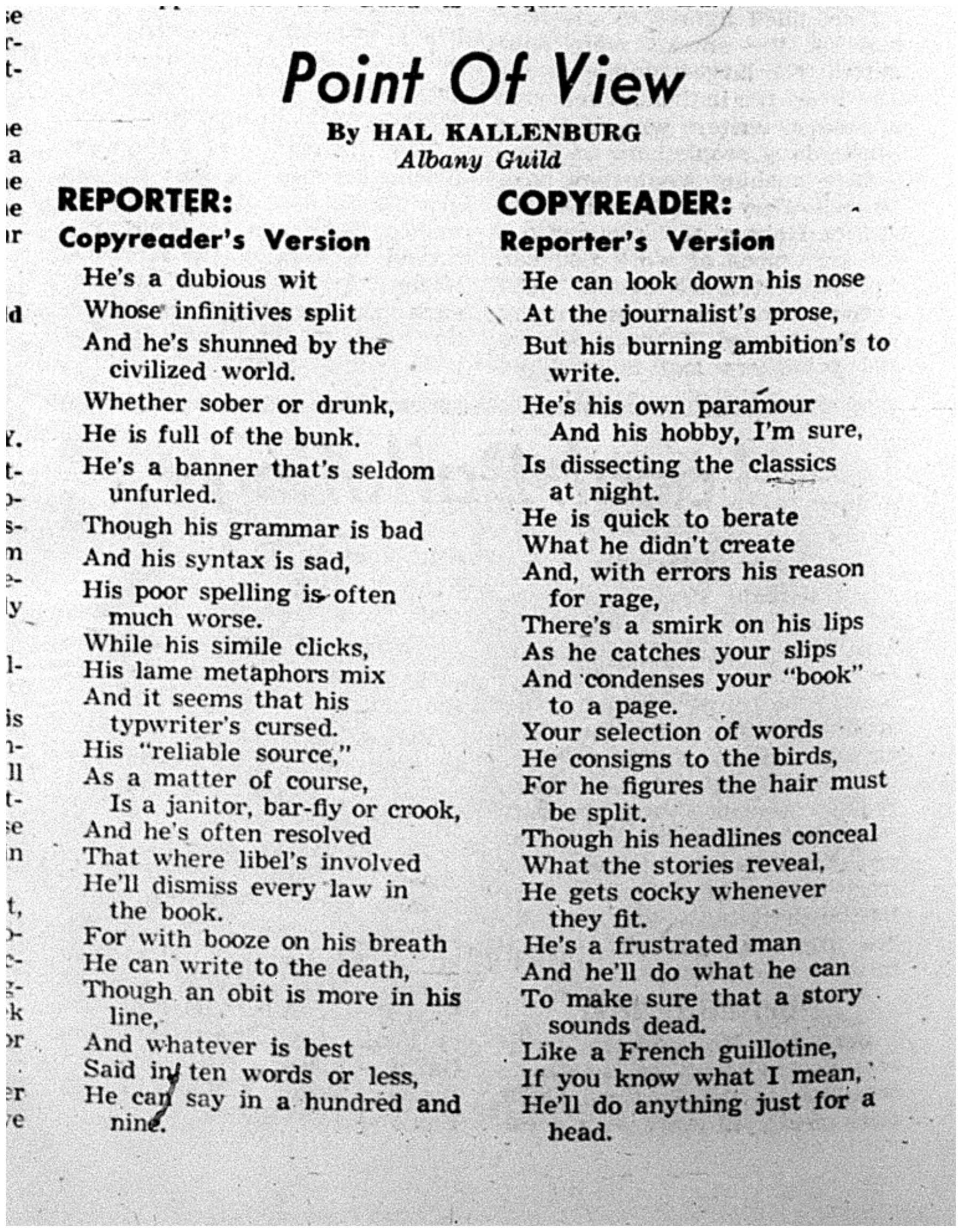
PUBLIC RELATIONS
Click Here for Alphabetized List of Authors on Public Relations Practitioners
PRDepiction: Public Relations in Books, Film, TV and radio is a collaborative blog devoted to the collection and publication of information about depictions of public relations on film, television and radio, and in books. It is edited by Professor Tom Watson of the Media School at Bournemouth University in England, with assistance from colleagues around the world.
Public Relations in Film and Fiction, 1930 to 1995, by Karen S. Miller, Journal of Public Relations Research 11 (1):3-28, 1999. Miller is an associate professor of advertising and public relations in the College of Journalism and Mass Communication at the University of Georgia.
PR Goes to the Movies: The Image of Public Relations Improves from 1996 to 2008, by Carol Ames, Public Relations Review, Volume 36, Issue 2, June 2010, pp. 164-170. Ames, who is on the faculty of the department of communications at California State University at Fullerton, offers a qualitative analysis of public relations in popular Hollywood films from 1996 to 2008. She looks at three questions: first, how is the PR practitioner portrayed in recent films? Second, what kind of public relations activities and models of public relations are depicted? Third, how do other scholars' results in prior studies apply to the portrayal of public relations in current films? Results show that for major films from Mars Attacks! (1996) to Hancock (2008), public relations practitioners are more credible, respected and influential, and PR work is more varied and complex than found in studies of films through 1995. The article outline includes an introduction and literature review, the status and credibility of public relations, depictions of PR in print and broadcast news, depictions of PR practitioners in film, research, metodology, PR in the movies 1996-2008 sample, and then an analysis of Wag the Dog (1997), The Kid (2000), America's Sweethearts (2001), People I Know (2002), Phone Booth (2002), Miss Congeniality 2: Armed and Fabulous (2005), Jersey Girl (2006), For Your Consideration (2006), Sex and the City (2008), Hancock (2008), results, discussion and references.
Learning About Public Relations from Television: How is the Profession Portrayed? by Youngmin Yoon, professor, School of Media and Communication, Korea University, and Heather Black, Research Associate, Berrier Associates in Communication Science, Vol. 28, Issue 2, 2011, pp. 85-106 including one-page abstract in Korean language.This qualitative study examined how public relations is portrayed in prime time television programming in the United States. As a first look at public relations portrayals in television dramas and sit-coms, results confirm many of the conclusions from other studies of entertainment media: (1) public relations as a field is still portrayed negatively; (2) the field is not well-defined, mostly as publicity and party planning; and (3) the field looks “easy” and “glamorous.” New insights were gained into the portrayal of public relations on television including: (1) the association of the term “public relations” with negative and “silly” actions; (2) society’s expectation of immoral behaviors from PR practitioners; (3) the portrayal of gender barriers; and (4) a tendency to focus only on practice areas dealing with the rich and powerful elements of society.
The Portrayal of Public Relations Practitioners in The West Wing," by Emily Kinsky, Texas Tech University.a paper presented at the 2006 AEJMC Convention in San Francisco. An investigation of the portrayal of public relations practitioners was performed using content analysis of the 22 episodes in the debut season of The West Wing. The practitioners were coded based on demonstrated traits and work performed or discussed. Significant differences were found between male and female practitioners being included or disciplined, appearing as major characters, dealing with government officials and the media, discussing speech writing, and appearing silly.
Perception of Public Relations: An Experiment Testing the Impact of Entertainment Portrayals of the Profession on Students and Practitioners, Kaye D. Trammell, University of Georgia and Lisa K. Lundy, Louisiana State University, a paper presented at the 2006 AEJMC Convention in San Francisco. Researchers investigated the impact of entertainment portrayals of the public relations profession. Findings indicate that while all groups believe the portrayal of the profession in the stimulus was inaccurate, participants allowed the entertainment program to cloud their perception of public relations. Respondents experienced third-person effects but the phenomenon dissipated as one's connection to the profession decreased.
Effects of Entertainment Television Program Viewing on Student's Perceptions of Public Relations Functions, by Youjin Choi, University of Florida, a paper presented at the 2006 AEJMC Convention in San Francisco. This study conducted a survey with students in an introductory public relations course to examine the effects of television viewing of entertainment programs with public relations characters on the perceptions about public relations functions. A factor analysis classified students;' perceptions into five categories: two-way communications, political communication, spokesperson , writing, and informal media relations.
Queer Eye for the PR Guy in American Films, 1937-2009 by Carol Ames, The IJPC Journal, Volume 2, Fall 2010, pp. 108-152. This qualitative study uses queer theory and scholarship about the image of journalist in popular culture and the image of the public relations practitioner in American films to study the changes in the presentation of the gay PR practitioner in films from the era of the Production Code (1930 to 1967) through the present. Comparing film depictions of gay and queer PR characters reveals the extent to which film plots cater to the heterosexual “norm.” At the same time, plot devices such as the “temporary transvestite” and image consulting to teach someone how to be “more like a girl” or “more like a guy” play with the audience’s often unconscious non-heterosexual (i.e., queer) desires and imaginings.
First Impressions: US Media Portrayals of Public Relations in the 1920s, by Timothy Penning, School of Communications, Grand Valley State University, Allendale, Michigan, Journal of Communication Management, Vol. 12, No. 4, 2008, pp. 344-358. The paper traces negative and limiting media depictions of public relations (PR) to their origins in the 1920s in order to determine whether modern media characterizations of "public relations" are new or a legacy of the past.
PRDepiction -- images of the public relations practitioner in books, film, TV and radio. In 2007, Tom Watson (Bournemouth University) asked PR educator colleagues in the UK for help in developing a list of films, television and radio programmes/series and books that either featured public relations as a core issue or referred to it in a notable manner. They responded enthusiastically with suggestions that went back into the 1950s and forward to the present including films on current release and a soap opera set in a real PR consultancy in Manchester, UK. It was added to in 2008 and several times in 2011 with other references. A wonderful web site for anyone interested in the image of the public relations practitioner in popular culture.
Girls on Screen: How Film and Television Depict Women in Public Relations by Jane Johnston, Bond University, PRism 7(4): http://www.prismjournal.org. 2010 This paper explores how women in public relations have been depicted in the popular culture forms of film and television. With some reference to early screen depictions, it focuses primarily on film and television from the past two decades, analysing women in a variety of public relations roles in the 1900s and 2000s. The study looks at nine leading television series and movies from the United States and United Kingdom to examine how women in public relations are portrayed, and also colates the data from previous studies to defvelop a profile of how depictions have changed since the 1930s. Primarily, it seeks to locate these depictions of women on screen within the spectrum of feminist and post feminist theory, both specific to public relations and from a wider perspective. It then draws on a range of thinking from popular memory, cultivation analysis and the public sphere to explain how these depictions become embedded within popualr (mis) understandings of the profession).
Crime has a PR component: Public relations in U.S. mystery novels by Karen Miller Russell, College of Journalism and Mass Communication, University of Georgia. Public Relations Review 50 (2024 102396. Qualitative content analysis of 74 novels featuring public relations characters distributed in the United States demonstrates that, rather than attempting to replicate reality, the mystery genre reflects debates about such issues as honesty, confidentiality, and the relative value of negative publicity. PR practitioners fit into all of the conventional mystery character roles, but particularly the role of sleuth, where access to information and powerful people allows them to solve the mystery but also sometimes forces them to choose between the client/employer and the public interest.
ART AND PHOTOGRAPHY
Click Here for Alphabetized List of Authors on Journalists in Art and Photography
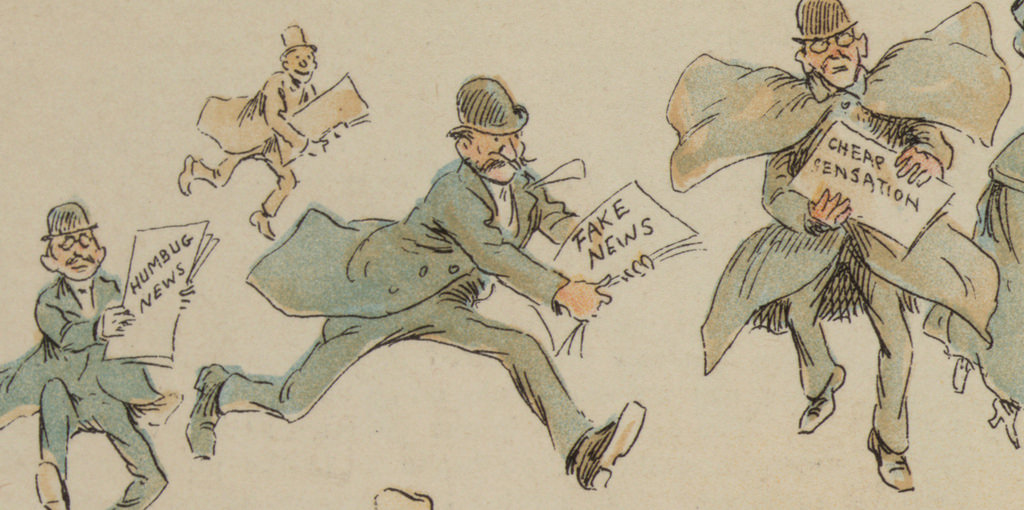
Yellow Journalism: Fake News in the 19th century.
n Norman Rockwell Visits a Country Editor, Rockwell captures the essence of working in a bustling local newsroom. Rockwell invested a lot of time researching the locations for his illustrations, and in this case, he investigated the inner workings at the Monroe County Appeal in Paris, Missouri. Rockwell had an intense interest in being as accurate with details as possible. During his time researching the newsroom, President Roosevelt passed. The gentleman in the foreground is shown reading the front page of the newspaper with the headline "Death Comes to President".
n Norman Rockwell Visits a Country Editor, Rockwell captures the essence of working in a bustling local newsroom. Rockwell invested a lot of time researching the locations for his illustrations, and in this case, he investigated the inner workings at the Monroe County Appeal in Paris, Missouri. Rockwell had an intense interest in being as accurate with details as possible. During his time researching the newsroom, President Roosevelt passed. The gentleman in the foreground is shown reading the front page of the newspaper with the headline "Death Comes to President".
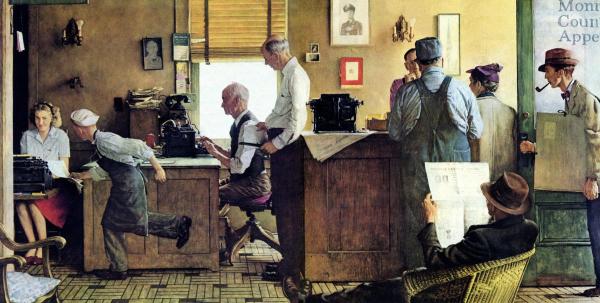
Norman Rockwell Visits a Country Editor 1946
In Norman Rockwell Visits a Country Editor, Rockwell captures the essence of working in a bustling local newsroom. Rockwell invested a lot of time researching the locations for his illustrations, and in this case, he investigated the inner workings at the Monroe County Appeal in Paris, Missouri. Rockwell had an intense interest in being as accurate with details as possible. During his time researching the newsroom, President Roosevelt passed. The gentleman in the foreground is shown reading the front page of the newspaper with the headline "Death Comes to President".
Art Critic by Norman Rockwell, April 16, 1955.
The art critic studying a locket in the painting is Jerry Rockwell, the oldest son of the artist. The whimsical lady in the painting is his mother, Mary (Rockwell added flaming red hair for fun). Should the student notice the painting looking back at him or look over his shoulder to see the Dutch gents glaring at him, I suspect he would run screaming from the museum and take up another subject to study.

The Great Debate by Norman Rockwell, 1948

Commuters (Waiting at Crestwood Train Station) by Norman Rockwell, November 16, 1946
All the commuters are reading newspapers and a newsboy is selling his newspapers at the Crestwood Train Station gate as late-comers arrive.

Street Scene of a crowd, each person reading a newspaper bought from a news-seller’s kiosk, by Ethel Spowers in Australia, 1936, linocut printed in color from four blocks (mauve, viridian, yellow ochre, dark blue). Edition of 50.
"Now -- You Take in Reel Life" -- common film tropes about reporters in the late 1930s and early 1940s drawn by Walt Munson of the New Haven (Conn.) Register for Editor & Publisher, April 20, 1940. Submitted by Will Mari, UW Dept. of Communication
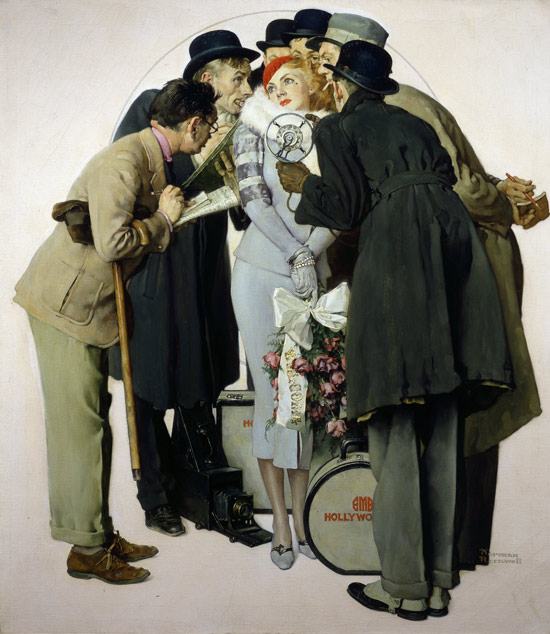
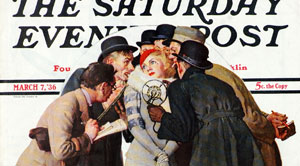
Movie Starlet and Reporters by Norman Rockwell (1936, Saturday Evening Post cover, March 7, 1936. ©1936 SEPS: Licensed by Curtis Publishing, Indianapolis, IN. Tear sheet currently on view and from the permanent collection of Norman Rockwell Museum.
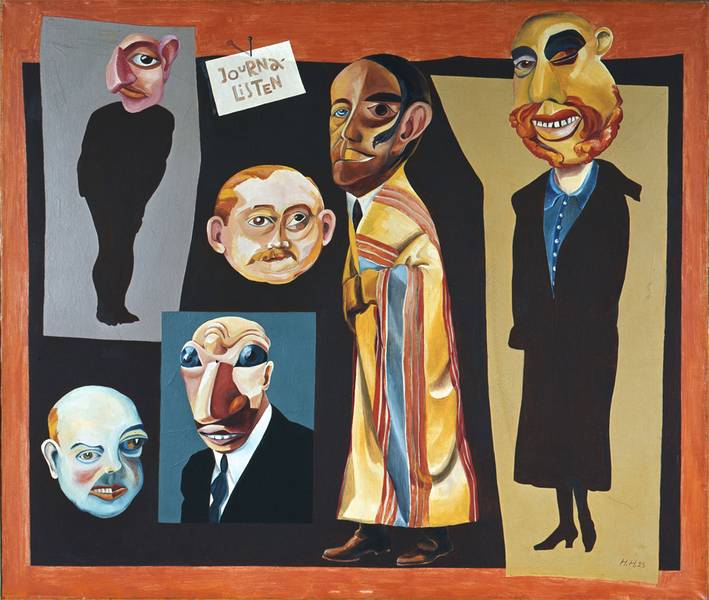
The Journalists, 1925 - Oil on canvas - 86 x 101 cm
Acquired with funds from the Foundation DKLB and budgetary funds of the Senator for Science and Art, Berlin
© VG Bild-Kunst, Bonn 2011
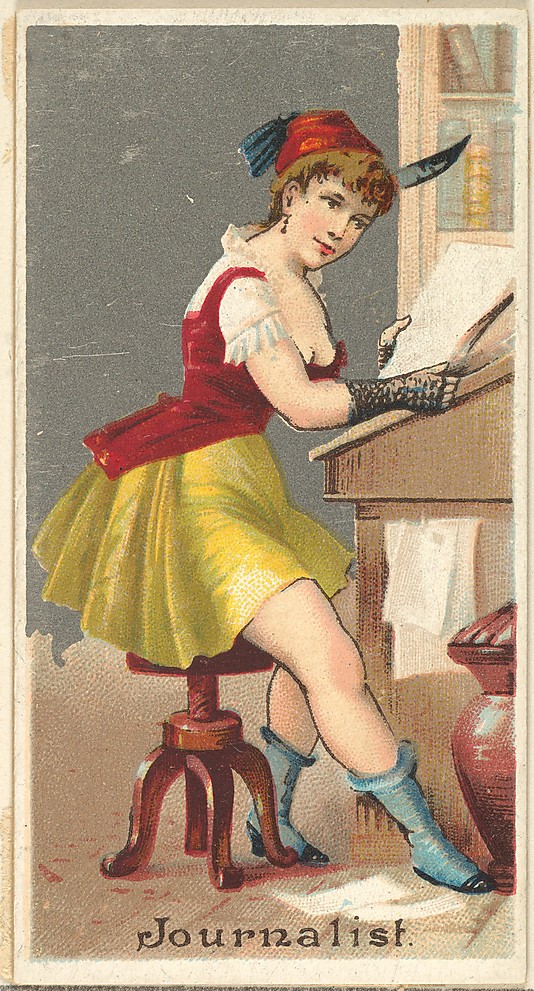
Portrait of a Female Journalist. 1887. Part of the "Journalist, from the Occupations for Women series (N166) for Old Judge and Dogs Head Cigarettes." From the new Metropolitan Museum of Art Online images collection:
Satirical Image of Heywood Broun. The work of Honoré Daumier inspired Peggy Bacon's interest in caricature and satire, and in 1928 she learned the art of lithography. In the fall of 1930 Bacon dashed off her satirical image of the journalist Heywood Broun for an American Printmakers exhibition. This picture of Broun at his typewriter was published in Bacon's compilation Off with Their Heads! (1934), with her description: "Sits in black leather chair with floppily crossed feet in god-awful mess of letters and litter. Looks like a stage elephant made of two men. Mild, journalistic anxiety stamped on face. Must-get-the-article-in look.”

The Morning News by Frederick James Boston, 1887. On view at the American Art Galleries, 5th Floor, Visions and Myths of a Nation 1800-1890. “Who wouldn’t prefer a newspaper to dirty dishes? Paintings of women reading newspapers were rare in the 1880s, and those featuring working-class mothers or maids even rarer. With few exceptions, newspapers were still the purview of men. While he was an art student in Paris in the 1880s, Frederick Boston may have seen Mary Cassatt’s Impressionist portraits of her wealthy female relations reading newspapers. In the 1890s, Boston became a major figure on the Brooklyn art scene and served as the first art instructor at the fledgling Brooklyn Museum. Oil on canvas.

The Newsboy by George Wesley Bellows, 1908. On View: American Art Galleries, 5th Floor, The City and the Rise of the Modern Woman, 1900-1945. Like his teacher and colleague Robert Henri, George Bellows gravitated toward the depiction of children as urban “types.” Here, he portrays a working-class newsboy, a popular subject for artists, documentary photographers, and writers around the turn of the twentieth century. The energetic brushwork conveys an impression of a spirited character, yet Bellows’s portrait of his sitter—an Irish child identified simply as Jimmy Flannigan in the artist’s record book—also veers toward the grotesque. The boy’s mischievous expression and caricatured features—particularly his pronounced ear and spindly hands—suggest how the artist relied on prevailing race- and class-based stereotypes.

Family Group with Newspaper, 1936 by photojournalist James Van Der Zee. Arranged in a balanced and harmonious triangular composition, the family group reads the newspaper in front of a painted backdrop that suggests a bucolic setting.
Images of the Combat Journalist – Reality & Fantasy, a power point presentation by Dr. David Natharius, Adjunct Professor, Walter Cronkite School of Journalism and Mass Communication, Arizona State University. Presented to the Western States Communication Association Convention, Albuquerque, NM, February 15, 2004, and to the National Communication Association (NCA) Convention, Chicago, IL, Nov. 12, 2004.
Journalist in Art and Cartoons on the Web
Reporter's Ensemble, The Year 2027
Nora Paul, director, Institute for New Media Studies, University of Minnesota, has a newspaper art collection of postcards and memorabilia, an extraordinary collection.
A Cub Reporter -- Life Magazine - 1912
Art Explores truth through piece that will wear away at Mia. Jonathan Herrera Soto aims to honor murdered Mexican Journalists by Euan Kerr, Minneapolis, MN. July 19, 2019.
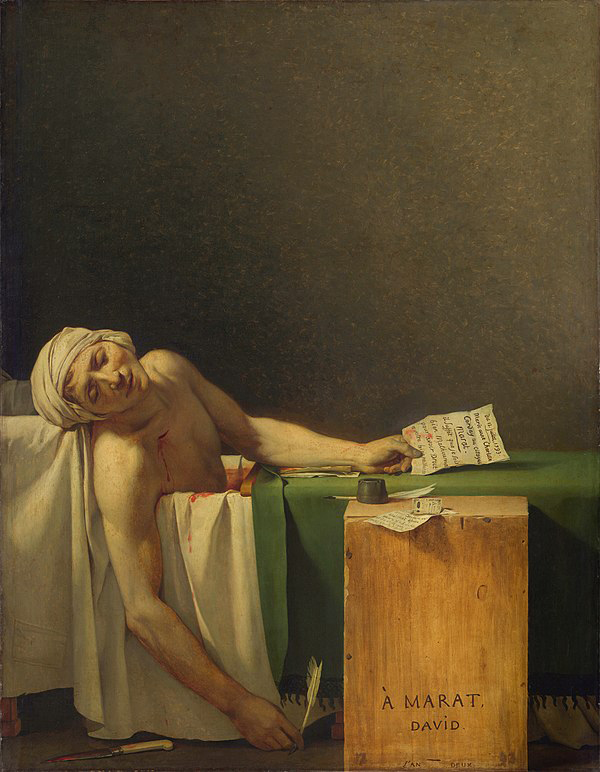
Death of Marat -- A 1793 painting by Jacques-Louis David of the murdered French revolutionary leader-propagandist-journalist Jean-Paul Marat. It is one of the most famous images of the French Revolution. David was the leading French painter, as well as a Montagnard and a member of the revolutionary Committee of General Security. The painting shows the radical journalist lying dead in his bath on 13 July 1793, after his murder by Charlotte Corday. Painted in the months after Marat's murder, it has been described by T. J. Clark as the first modernist painting, for "the way it took the stuff of politics as its material, and did not transmute it".

David Hinds, Nellie Bly, American Journalist Nellie Bly (aka Elizabeth Jane Cochran) , 2020

Stephen Warde Anderson, "Girl Reporter," 2008.

CI Doughty, Emile Zola Surrounded By Reporters

L'ere nouvelle, 1922. With the Revolutionary bonnet rouge upon her head, a literal "paper-girl" cries out that it is a New Era –– which is the name of a strident French leftist paper, "the great daily of the Leftist bloc," which was in operation from the mid-1800s to 1941. Three years after this announcement, editor Albert Dubarry grew incensed that Leftists were considering creating a coalition government with parties on the Right, and resigned to found another, purer Leftist paper.

Graham Dean, Foreign Correspondent, 1996

Weatherman Was Right by Stevan Dohanos, April 27, 1946 Saturday Evening Post
New Yorker Covers

March 22, 1952 - by Leonard Dove - Society writer in all-male newsroom banging out a story on deadline on a typewriter in 1952

November 11, 1939 by Constantin Alajalov: Reporters in the press box at a horse show watching with disdain as an elegant couple types their story.

November 1, 1941 by William Cotton: Reporters surrounding a politician as he votes on election day.

October 27, 1951 by Leonard Dove: Reporters interviewing a football player in the locker room.

November 14, 2016 - Anything But That by Barry Blitt - Man reading newspaper on subway

March 26, 2018 - Exposed by Barry Blitt -- Reporters asking questions at Presidential press conference with Donald Trump

February 9, 1952 - "New Yorker February 9 1952" by Constantin Alajalov - Photojournalists at a dog show waiting to get a picture of the winner.

July 10, 1948 - by Peter Arno - View of a podium at a press conference topped with microphones identified with different networks monograms and the finger of the speaker, seen pointing upward.

March 8, 1941 - Peter Arno - Weary soldier in a tent being photographed and interviewed by the press.

March 15, 1941 - by Constantin Alajalov - Claw-like hands of newspaper articles representing Income Tax reaching for a small, frightened man.

November 15, 1969 - by Charles E. Martin - Newspapers on apartment doorsteps.

March 11, 2013 - Sic Transit Gloria Mundi by Barry Blitt - The Pope reading newspapers about the Catholic Church scandals
New Yorker Cartoons

January 12, 1998 - by Joseph Farris - "I was an investigative journalist until they investigated me." One prisoner to another in prison

June 14, 1930 - by Art Young - "I think I'll take the murder." Women to paperboy.

May 18, 1998 - by Tom Cheney - "I'm not really a journalist. I just play one on the evening news." Businessman to woman at cocktail party.

June 2, 1986 - by Lee Lorenz - "It's not just me, Doctor. He's been turning away from the New York 'Times' as well." Woman to doctor, referring to her husband, who sits nearby looking very sad.

August 3, 2021 - "Read All About It" by Jody Zellman - Newsboy selling newspapers with targeted ads based on the reader’s search history.

News-Boy 1898 from “London Types” painted by William Nicholson 1898. It is a late 19th century lithograph from a woodcut made by the celebrated printmaker Nicholson. This highly decorative work is a lithograph from the published series called London Types and shows a portrait of a London City, Newsboy. He is shown wearing a black cap with his yellow-colored hair poking out from below. He stands on a street corner with the daily newspapers flung over his shoulders. He looks at a rival paper seller taking a broadside to a gentleman driving a horse-drawn cart. He searches about for his next customer. Although not strictly a Cries of London series - some of these street characters often appear in antique prints stretching back through the previous centuries. They chronicle street life in London in the last part of the 19th century. The series was published in 1898 in the volume issued by Heinemann, London. The image size is 25.5 x 23 cm. Frame size is 39 x 36.5 cm. The image is printed in black ink on brown-toned paper to imitate the woodcuts and has touches of color to enliven the image here and there. The print is in good antique condition. The photographs here make the sheet look more of a drab-green color - rest assured that the paper is a nice buff color. William Newzam Prior Nicholson was a British painter of still-life, landscape and portraits. He also worked as a printmaker in techniques including woodcut, wood-engraving and lithography, as an illustrator, an author of children’s books and a designer for the theater including J.M. Barrie’s play, Peter Pan. Beginning in the 1890s, he created posters with his brother-in-law, the Scottish artist James Pryde. They used the pseudonyms J. & W. Beggarstaff. In 1897, Nicholson produced a woodcut print of Queen Victoria that was so well received that it established his reputation with the British public. Many of his prints were originally issued in a very small run of hand-colored woodcuts. Their popularity led to the images being transferred to lithographic stones and printed in a bound volume (such as my works listed for sale on my website). His unique style is instantly recognizable, with the broad strokes from his original woodcuts printed with subtle variations of earth tones, harking back to earlier British book illustrations. He was knighted in 1936. His children were the celebrated artists, Ben Nicholson and Nancy Nicholson. He was also the father of the architect, Christopher "Kit" Nicholson. He died in 1949.

.
COMIC BOOKS
Click Here for Alphabetized List of Authors on Journalists in Comic Books
Everything I Need To Know About Journalism I Learned From Superman
(And Other Comic Books) by Tom Henderson, managing editor of the Polk County Itemizer-Observer in Dallas, Oregon, and “Mild Mannered Reporter” columnist for the paper. He is also President of the Society of Professional Journalists Greater Oregon Professional Chapter.
"It's a bird...it's a plane...it's a journalist?" A Framing Analysis of the Representation of Journalists and the Press in Comic Book Films. A Thesis Submitted to the Faculty of the Graduate School of the University in Minnesota by Katherine Ann (Beck) Foss in partial fulfillment of the requirements for the Degree of Master of Art. October 2004.
"A Modern Asmodeus?Clark Kent, Journalistic Fantasies of Omniscience and the Panoptic Gaze" by Dr Hazel Mackenzie Department of English and Digital Media University of .(JavaScript must be enabled to view this email address) “In a strong sense, Superman is the mighty newspaper.”i It is interesting, and perhaps a little odd, that Clark Kent is possibly the twentieth century’s most famous fictional representation of a journalist (narrowly beaten by his own girlfriend Lois Lane), and yet so little attention has been paid to this aspect of his persona. Clark Kent is the journalist as superhero. Moreover, he is the first and most famous of superheroes. IJPC publication.
EXTRA! The Comic Book Journalist Survives the Censors of 1955 by Tom Brislin, Journalism History v. 21, pp. 123-130. Autumn, 1995. EXTRA! is a 1955 comic book that chose journalists as its protagonists. Unlike other comics that used the journalist to mask a secret superhero identity, such as Superman or Spider-man, EXTRA! portrayed the journal sits themselves, albeit in glorified form, as the heroes. EXTRA! built an impressive cast with an image of journalists that fit nearly into professional and gender stereotypes of the era. The male journalists were young, rugged and handsome, unencumbered by family, social, or community obligations. They were more likely to use their fists or a gun than a pen or camera. Women were easily divisible into "hard" and "soft" character types: Women journalists were "hard," equal in mettle to the males in the profession. The remainder of the sex was "soft," either in or making trouble. Women always played a part in getting the story; often they were the reward for male journalists afterward.
On the Front Line: Portrayals of War Correspondents in Marvel Comics' Civil War: Front Line by J. Richard Stevens, The IJPC Journal, Volume 1, Fall, 2009, pp. 37-69. The events of September 11, 2001 dramatically altered the daily routines, expectations, and social contexts that professional journalists normally follow in their production of news. Journalists found that maintaining a critical distance from various sides in a conflict was difficult in the wake of the terrorist attacks on American soil. As a result, the Patriot Act was passed and military action authorized with little or no critical discussion in the press. Recently, Marvel Comics published a comic book series titled Front Line as a companion to its Civil War miniseries. Many of the themes, arguments, and actions performed in Front Line, which is set in a world with super humans, demonstrate the complexities faced by journalists during times of extreme stress (such as enduring a domestic event of mass destruction). This article examines the performance, behavior, and treatment of the Front Line reporters as they operate in their professional capacity to uncover truth, and finds parallels with the news media’s performance following September 11.
“Daily Planet” Vs. “Daily Bugle”: The Changing Depiction of Journalism in American Comic Books, by Andrew Alan Smith, a thesis in partial fulfillment of the requirements for the degree of Master of Arts, University of Memphis School of Journalism. Journalists and journalism have always been popular vehicles for storytelling in comic books, as they are in other pop culture media. The more than 70 years of comic books in America have provided thousands of fictional journalists, especially in the superhero genre. Primary among these are the staffs of the Daily Planet at DC Comics and the Daily Bugle at Marvel Comics. This content analysis – utilizing hundreds of the original texts but also historical research and a questionnaire to significant creators – shines a spotlight on a quantum shift in the depiction of journalists in comics. Until the introduction of Daily Bugle publisher/editor J. Jonah Jameson in 1963, the altruism of the Daily Planet was the model for journalism in comic books. Afterward, the morally compromised and ethically confused Daily Bugle was more often the standard-bearer. As a result, today’s comics feature journalists as heroes, villains, and everything in between.
Comic Book Journalists Beyond Clark Kent by Bill Knight, The IJPC Journal, Volume 1, Fall 2009, pp. 138-146.
The Shared Mission of Journalists and Comic Book Heroes: Saving the Day by Paulette Kilmer, The IJPC Journal, Volume 2, Fall 2010, pp. 86-107. Superheroes in comic books circa 1930 to 1960 embody the archetype of the warrior, who struggles to make a difference in the world and always fights for what really matters. Superhero warriors assert their gifts: courage, discipline, strength, and skill to defend the helpless, right wrongs, and save the day. Journalists also sometimes play that role of protecting the public from evil. This article explores the juxtaposition of reality and fiction essential to the comic book plots that idealize newspapers by presenting journalists as heroes. Indeed, these fantasy protagonists and living reporters share the mission to serve the public, expose wrongdoing, and minimize harm.
Super Reporters! by Matt Walz, Moviepilot March 6, 2015. What do Superman and Spider-Man have in common besides their color schemes? Well, each have civilian identities-and each works for the foremost newspaper in their respective universes. Journalism has been tied to superheroes and comics more than any other profession besides "mad scientist". So who in comics joined the ranks of the press, and why?
L'alba di Superman: Lois e Clark dal New Deal alla guerra, 1941-1945 (The Dawn of Superman: Lois and Clark from the New Deal to the 1941-1945 War), by Illeano Bonfa, December 27, 2018. Italian. The first Superman comics were published during the New Deal. The problems faced by the New Deal (financial speculation, corruption, poverty, unemployment, social security) can be found in the comics. Siegel and Schuster, like many comics authors, were American Jews, a social group that typically supported Roosevelt and his politics. In the years leading to the 1941-1945 war the United States slowlky moved from isolationism to interventionism. Superman comics testify to this evoluation and indeed anticipate it. We then consider Lois Lane in the role of reporter and its narrative function, hinting at the evolution of the character.
Nellie Bly's life and journalism in comics and the adaptations of Ten Days in a Mad-House by Manuel Carvalho Coutinho, Journal of Graphic Novels and Comics, June 12, 2024. One hundred years have passed since Nellie Bly’s death and yet she continues to be celebrated for her journalism and for being a feminist icon. This is in part thanks to her reports on women’s poor working conditions and her trip around the world when it was unthinkable for a woman to take the journey alone. Bly also stands out for her undercover investigations, chiefly among them is when she feigned insanity to be committed to an insane asylum to reveal its cold-hearted conditions. Because of all of this, Bly has been the subject of many adaptations throughout the years, including in comics. However, Bly’s exploits in the asylum have been mostly absent from this medium. That is, until recently with the publication of four graphic novels. To explore this matter further, this study will start by approaching Bly’s career, followed by an analysis of her many comic features. Afterwards, this study will then consider the recent adaptations of Bly’s asylum report, while comparing it with her original work. Finally, we will seek to understand why it took so long to adapt it into the comic book medium. Coutinho, M. C. (2024). Nellie Bly’s life and journalism in comics and the adaptations of Ten Days in a Mad-House. Journal of Graphic Novels and Comics, 1–27. https://doi.org/10.1080/21504857.2024.2358994.
Reporting Matt Murdock’s Double Life: The Image of the Journalist in Marvel Comics, by Robby Wayne O'Daniel, a thesis presented for The Master of Science Degree, The University of Tennessee, Knoxville, May 2012. Popular entertainments often provide the general public with a construct for who a journalist is and what the work of a journalist entails. It is important to study journalists in the popular culture to understand how the idea of the journalist is conceived by those who do not go to newsrooms and do not have first-hand experience with how journalists work. In order to do their jobs, journalists must regularly interact with the public at large, gathering facts, coordinating appointments, interviewing and so on. If these people have a negative image of the journalist, it would be helpful for journalists to understand how and where that image might come from, in order to better communicate with the public at large and have greater ease in doing their jobs. Comic books, in particular, have received little academic interest. Yet in comic books like Daredevil, created by writer Stan Lee and artist Bill Everett, a supporting character – seasoned investigative journalist Ben Urich – is among the cast of characters, and throughout the narrative, characters interact with journalists and journalism. This thesis uses textual analysis to look at what kind of categories journalists and journalism are placed in throughout the pages of various Daredevil comics. Journalists are mostly portrayed as negative, yet many characters rely on journalism daily for major information and entertainment. Urich is portrayed as an excellent journalist by others, but at times, he acts like a reporting novice.
MUSIC
Click Here for Alphabetized List of Authors on Journalists in Music
Tabloid Suite: Four Pictures of a Modern Newspaper composed by Ferde Grofe in 1932 consists of Picture No. 1: Run of the News (3:31). Picture No. 2 – Sob Sister (5:23). Picture No. 3 – Comic Strip (3:11). Picture No. 4 – Going to Press (7:38). New CD just released.
"We Both Reached for the Gun" from the musical, Chicago (1976 on the Broadway stage, 2003 in the movies) with lyrics by Fred Ebb, Fred (Lyrics). John Kander (Music). Shows the manipulation of the media by an attorney in dynamic musical form. Tabloid Columnist Mary Sunshine. Attorney Billy & Reporters: "Oh Yes, Oh Yes, Oh Yes They Both, Oh Yes, They Both Oh Yes, They Both Reached For the Gun, The Gun, The Gun, The Gun Oh Yes, They Both Reached For The Gun, For the Gun." Mary Sunshine: "You poor dear! I can't believe what you've been through! A convent girl! A runaway marriage! Oh, it's too, too terrible. Now tell us, Roxie…." Reporters: "Why'd You Shoot Him?"… What's your Statement?…" Mary Sunshine dances with Billy: "Understandable. Understandable." With Billy: "Yes, It’s Perfectly Understandable." Mary Sunshine bounces in mid-air pulled by strings. Billy and Mary: "Comprehensible. Comprehensible." Mary Sunshine picks up Roxie and puts her back in Billy's lap. "Not a Bit Reprehensible. It's So Defensible." Reporters: "Oh Yes, Oh Yes, Oh Yes, They Both, Oh Yes, They Both Reached For…" Billy: "Let me hear it." Reporters: "The Gun, The Gun, The Gun, The Gun, Oh Yes, They Both Reached For The Gun, For The Gun." Billy: "Now you got it!" Mary Sunshine rips out an article on an Underwood and hands it to a Copy Boy. The sequence ends with a series of Chicago newspapers rolling off the presses with the headlines: "They Both Reached for the Gun."
"Whatchulooinat" by Whitney Houston in 2003 album, Just Whitney. Concerns Tabloid Editor of the National Enquirer. Letter to the editor disguised as an R-and-B song: "Messin' with my reputation, ain't even got no education. God is the reason my soul is free, and I don't need you looking at me."
"Dirt" from the 2002 Broadway musical, Sweet Smell of Success, sung by Gossip Columnist J.J. Hunsecker (John Lithgow). Entire musical involves newspaper and gossip columnists. Hunsecker is based on Gossip Columnist Walter Winchell in this musical adaptation of the 1965 movie.
"The Sky is Falling" from the TV children's program, Happily Ever After: Fairy Tales for Every Child: Henny Penny, a TV children's program created in 1999, with music and lyrics by Spencer Preffer and Steve Punkett. Reporter Henny Penny sings "The Sky is Falling" (performed by Patti Welch): ""I've got the biggest story ever heard, they will hang on every word, I'm going to be a famous bird. Yes, I've got the biggest scoop I've ever had. The story's bound to be my launching pad. The sky is falling, you'd better watch your head, the sky is falling, the headline will be read, and everybody will know before it falls, that I'm the best reporter of them all. I'm sure the Pulitzer is mine, I will sign the dotted line on a book deal so divine. Yes Hollywood will demand the movie's rights and I'll be on the stage on Oscar Night. The sky is falling, You'd better watch your head, the sky is falling, the headline will be read. And everybody will know before it falls, that I'm the best reporter of them all.The sky is falling, you'd better watch your head, the sky is falling, the headline will be read. Woodward and Bernstein won't even get a call, cause I'm the top reporter, the number one reporter, yes, I'm the best reporter of them all."I've got the biggest story ever heard, they will hang on every word, I'm going to be a famous bird. Yes, I've got the biggest scoop I've ever had. The story's bound to be my launching pad. The sky is falling, you'd better watch your head, the sky is falling, the headline will be read, and everybody will know before it falls, that I'm the best reporter of them all. I'm sure the Pulitzer is mine, I will sign the dotted line on a book deal so divine. Yes Hollywood will demand the movie's rights and I'll be on the stage on Oscar Night. The sky is falling, You'd better watch your head, the sky is falling, the headline will be read. And everybody will know before it falls, that I'm the best reporter of them all.The sky is falling, you'd better watch your head, the sky is falling, the headline will be read. Woodward and Bernstein won't even get a call, cause I'm the top reporter, the number one reporter, yes, I'm the best reporter of them all."
"Dirty Laundry" sung by Don Henley in 1982: Journalist's cry, ""Come and whisper in my ear….We love dirty laundry."" Refrain shouts: ""Kick 'em when they're up. Kick 'em when they're down. Kick 'em all around."
"Extra, Extra" from the 1942 film, The Blazing Trail, Editor Smiley Burnett of the Bradytown Bugle hawking his papers and singing: "Extra. Extra here. Buy a paper. Extra. Extra here. You can read all about it. All the latest gossip on the beat. Tells you what you want to know and who’s been doing what. Buy it for two cents a sheet. Extra, extra, here you can read all about it. The bulldog edition’s on the street. Plumb full of scandals, swindles and fights. Buy it for two cents a sheet."
"Jimmy Olsen's Blues," from the 1991 Spin Doctors album, "Pocket Full of Kryptonite."Cub Reporter-Photographer Olsen is in love with Reporter Lois Lane and laments he can't compete with Superman. "Well, I don't think I can handle this A cloudy day in Metropolis I think I'll talk to my analyst I got it so bad for this little journalist. It drives me up the wall and through the roof Lois and Clark in a telephone booth. I think I'm going out of my brain I got it so bad for little miss Lois Lane. Lois Lane please put me in your plan Yeah, Lois Lane you don't need no Super Man. Come on downtown and stay with me tonight, I got a pocket full of kryptonite.He's Leaping buildings in a single bound I'm reading Shakespeare at my place downtown. Come on downtown and make love to me, I'm Jimmy Olsen not a titan, you see. He's faster than a bullet, stronger than a train. He's Leaping buildings in a single bound I'm reading Shakespeare at my place downtown. Come on downtown and make love to me, I'm Jimmy Olsen not a titan, you see. He's faster than a bullet, stronger than a train…"
Meet John Doe: The Musical, lyrics by Eddie Sugarman and music by Andrew Gerle, premiere in Washington D.C. Ford Theatre, 3-27-2007. Reporter Ann Mitchell loses her job in the middle of the Depression so she prints a phony letter from a “John Doe” who, protesting the state of society, promises to jump off the Brooklyn Bridge on Christmas Eve. Circulation goes through the roof and she convinces her editor to hire an out-of-work ballplayer to stand in for John Doe. The ambitious newspaper reporter ghost writes the “John Doe” column. With his words and his down-home charm, John Doe quickly becomes a national sensation. When the paper’s powerful owner reveals true plans for John Doe, both Ann and John must confront what they’ve created and decide what they truly believe in.
"I'm Your Man" from the musical, "Meet John Doe." Lyrics by Eddie Sugarman and Music by Andrew Gerle. Reporter Ann Mitchell sings this song to Editor Richard Connell trying to get her job back on the paper: “You want fireworks? I’ll give ya the Fourth of July! Lots of luck finding somebody better than I. Simply smashing. Really, Chief, you’re quite astute. Your plane’s crashing -- and you ditch your parachute.
You need someone with talent and passion and brains. You need someone with newspaper ink in their veins. No coffee cup has lipstick stains, but Brother, I’m your man.
I’ll write just what you say, anyway that you want. And when it comes to arguing I’m a savant!
Use my column, Any topic, take your pick. I can slalom Back and forth on rhetoric! You need someone who crosses her legs and her T’s. I’m so quick that I’ve got my own personal breeze.
I’ve got high heels and two of these, but Brother I’m your man.
I don’t need this position! So go on and throw out a gem. You have stiff competition. Dick! You can go to hell. I’ll go and work for them! Anything you need done, I’m the one for the job.
You want corny? I’ll type it right off of the cob. I need money, You need me to make a stir. Rent my fingers, I’ll throw in a Pulitzer!
Front Page headlines will keep Mom and me off the street. Come tomorrow some editor’s in for a treat. Just say the word, and that’s my beat! Brother, I’m your man.
Watch out, New York. Here comes -- Ann!.
"Paparazzi" by Lady Gaga, 2009.
We are the crowd, we're c-coming out
Got my flash on it's true, need that picture of you
It's so magical,
We'd be so fantastical
Leather and jeans, garage glamorous,
Not sure what it means, but this photo of us
It don't have a price, ready for those flashing lights,
'Cause you know that baby I
I'm your biggest fan I'll follow you until you love me,
Papa-paparazzi,
Baby there's no other superstar you know that i'll be your
Papa-paparazzi
Promise i'll be kind, but i won't stop until that boy is mine,
Baby you'll be famous chase you down until you love me,
Papa-paparazzi
I'll be your girl, backstage at your show,
Velvet ropes and guitars, yeah 'cause you're my rockstar,
In between the sets, eyeliner and cigarettes,
Shadow is burnt, yellow dance and we turn,
My lashes are dry, purple teardrops I cry,
It don't have a price, loving you is cherry pie
'Cause you know that baby I
I'm your biggest fan I'll follow you until you love me,
Papa-paparazzi,
Baby there's no other superstar you know that i'll be your
Papa-paparazzi
Promise i'll be kind, but i won't stop until that boy is mine,
Baby you'll be famous chase you down until you love me,
Papa-paparazzi
Real good, we dance in the studio,
Snap, snap to that xxxx on the radio
Don't stop, for anyone,
We're plastic but we still have fun!
I'm your biggest fan I'll follow you until you love me,
Papa-paparazzi,
Baby there's no other superstar you know that i'll be your
Papa-paparazzi
Promise i'll be kind, but i won't stop until that boy is mine,
Baby you'll be famous chase you down until you love me,
Papa-paparazzi
Beatrice Fairfax, Tell Me What To Do - 1915
Little Marjorie, hard working girl was she,
She met a nice young fellow
As charming as could be;
At sight they loved each other,
On air they seemed to float,
Instead of asking mother,
She sat right down and wrote:
“Oh, Beatrice Fairfax, what shall I do?
I want the bare facts, the truth from you;
I have a nice young sweetheart,
The best a girl could get,
Although he’s always teasing, he hasn’t kissed me yet.
Oh, darling Beatrice, It’s up to you,
So print my answer, kindly do!
He takes me out to dances,
Now should I take those chances?
Beatrice, Beatrice, tell me what to do! Oh Beatrice do!
Ev’ry single night, a perfumed note she’d write,
She’d ask a million questions,
But still she was police;
He’d cut such funny capers,
Her mind was so upset,
That lovelorn on the papers
These little notes would get:
Oh, Beatrice Fairfax, what shall I do?
I want the bare facts, the truth from you;
I have a nice young sweetheart, he is a darling chap,
He doesn’t care for fat girls, ‘cause they roll off his lap.
Oh, darling Beatrice,
It’s up to you,
So print my answer, kindly do!
Pa said, that he’s a loafer,
But I know he’s a chauffeur,
Beatrice, Beatrice, tell me what to do!
Oh, Beatrice, do!
To church I tried to get him,
He say, his wife won’t let him.
Beatrice, Beatrice, tell me what to do!
Oh, Beatrice, do!